
Last updated November 2, 2026
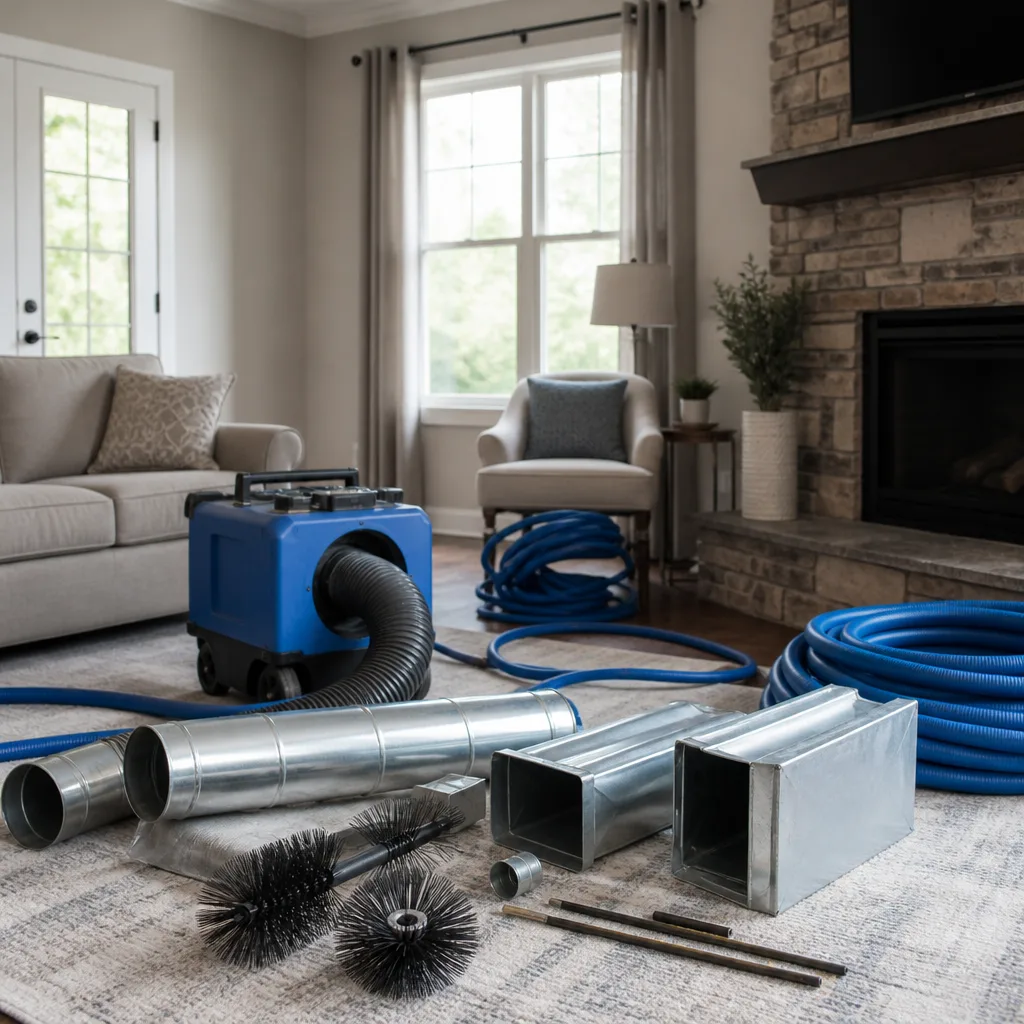 Whole-home duct cleaning
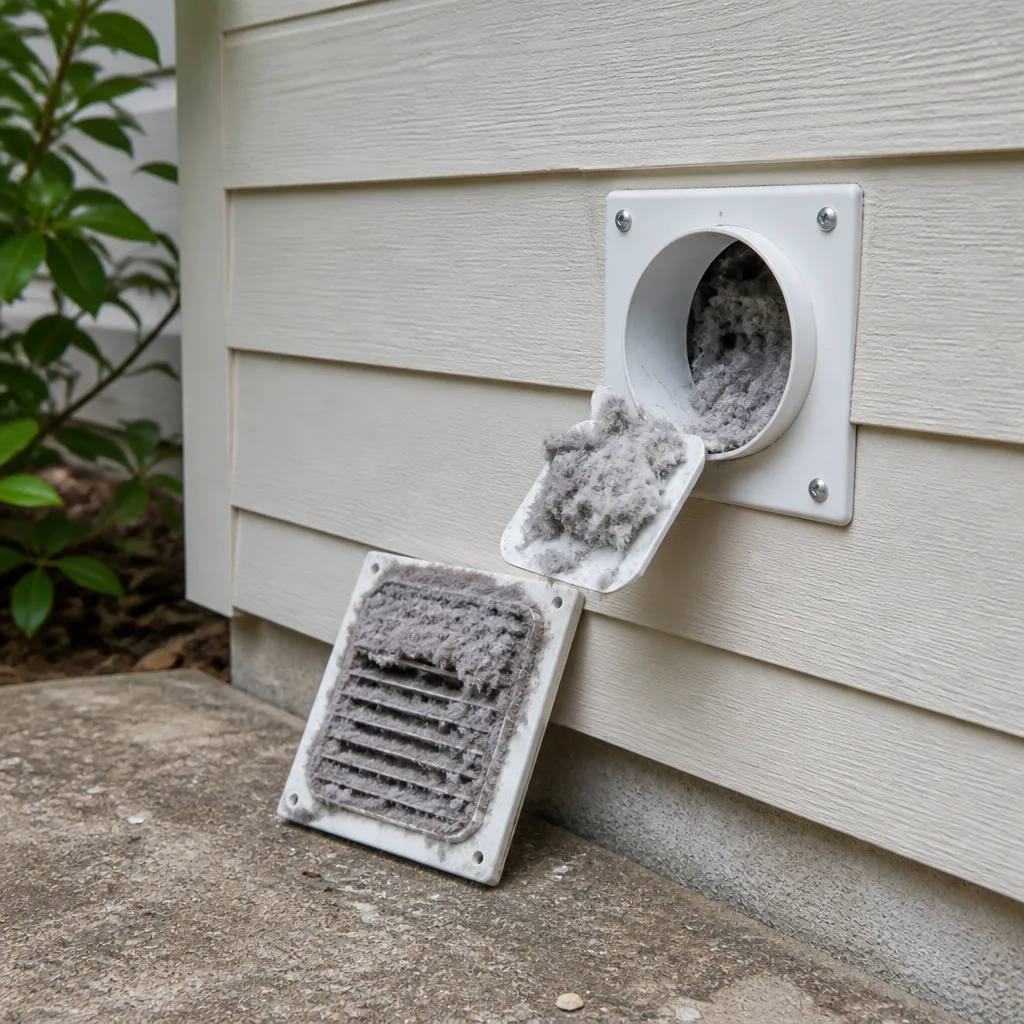 Dryer vent cleaning
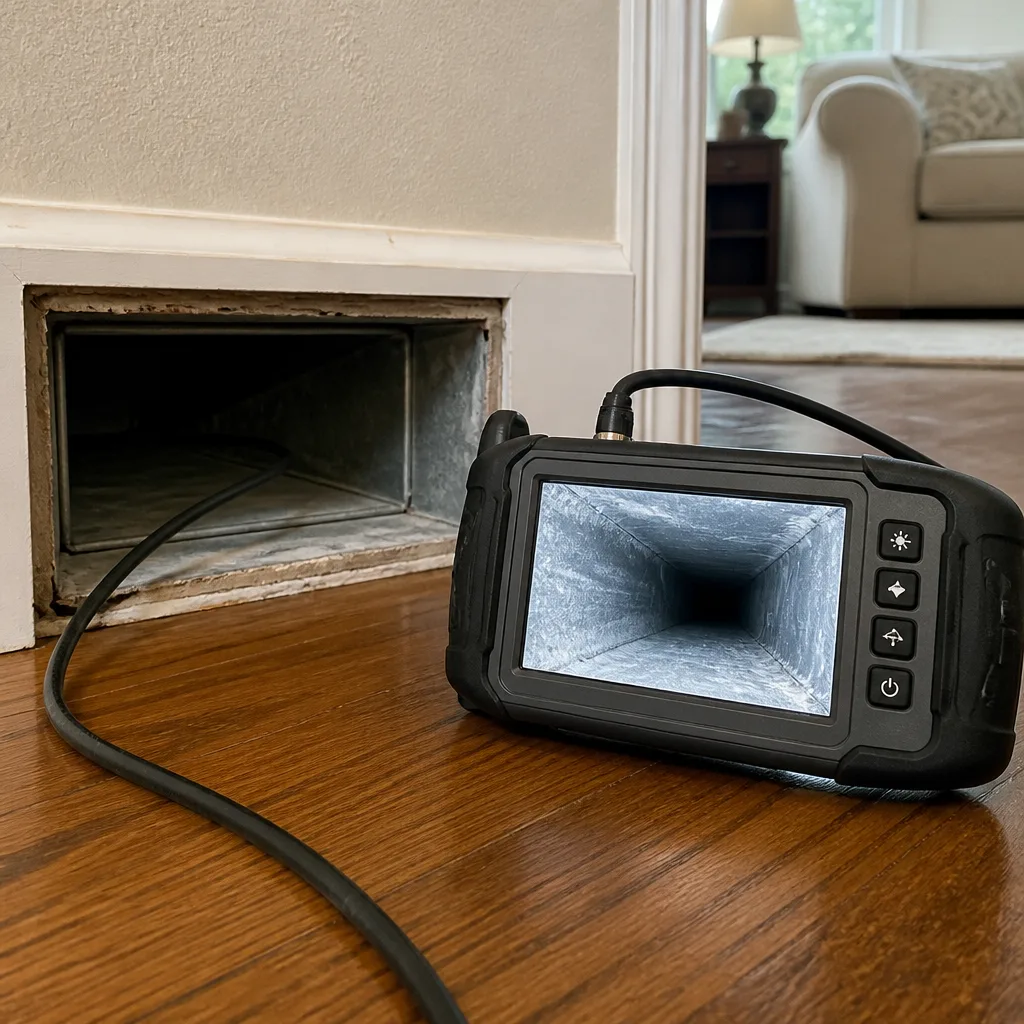 Camera inspection
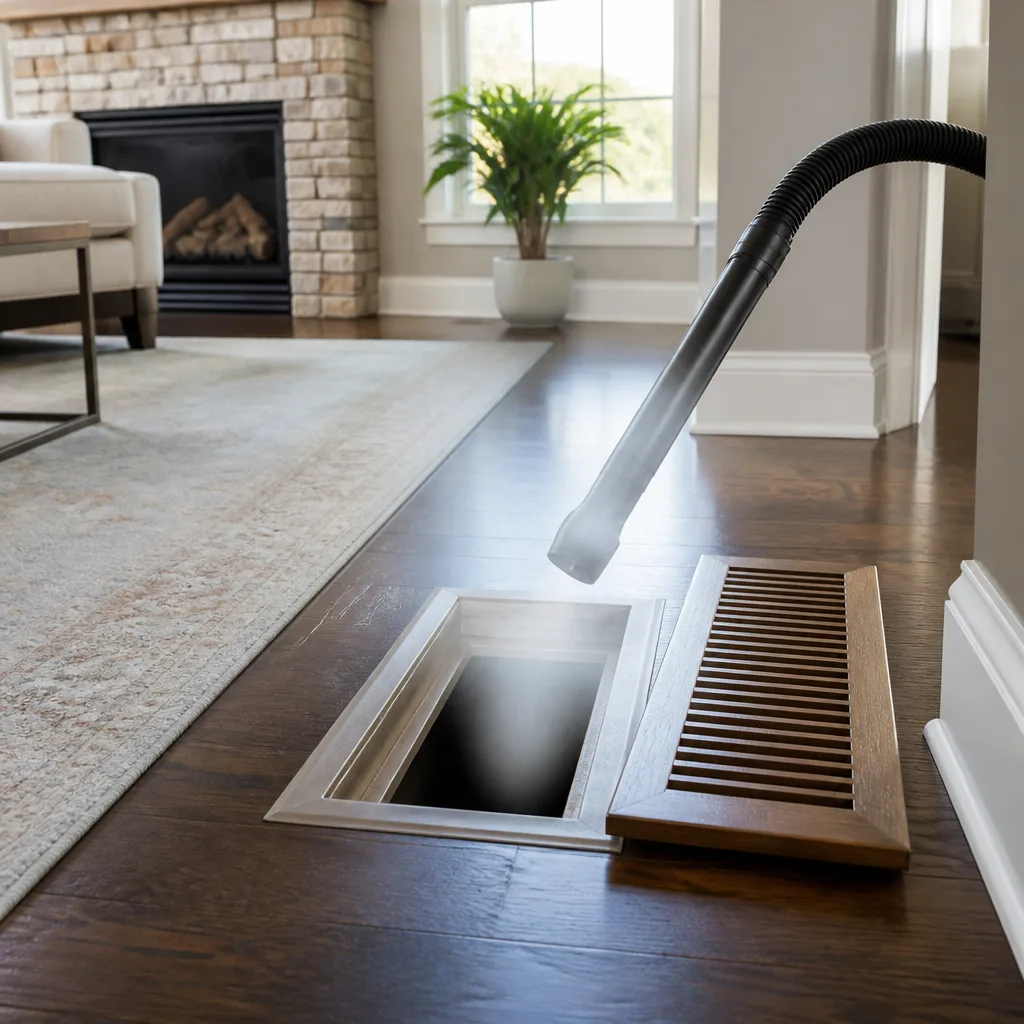 Sanitizing & deodorizing
Whole-system duct and dryer vent check with before-and-after photos - you see exactly what came out of your vents
That "$99 whole-house special" is a bait ad - the real number appears once they are in your hallway, or the "clean" is a shop-vac at the register. We photograph the inside of your ducts before and after instead.
Seasonal Air Duct Cleaning Care for Mira Mesa: Year-Round Homeowner’s Guide
During a Santa Ana wind event, particulate matter in inland San Diego communities can spike so sharply that it loads a duct system in 72 hours with what normally accumulates over months. Most seasonal maintenance advice ignores this entirely, treating Mira Mesa as if it has the same four textbook seasons as Ohio or Minnesota. It doesn’t. What Mira Mesa has is a distinct set of climate stress periods, each one depositing something different into your ductwork, and each one demanding a slightly different response. This guide maps air duct care to those real local cycles so you know what to check, when to check it, and what’s actually worth paying for. We’ll cover the marine layer’s humidity risks, summer canyon heat, Santa Ana particulate surges, wildfire smoke residue, and the winter recovery window that most homeowners waste.
Styles & brands we work with
- Whole-home duct cleaning
- Dryer vent cleaning
- Camera inspection
- Sanitizing & deodorizing
Quick Answer
In Mira Mesa, our Air Duct Cleaning services should be timed to the late-summer Santa Ana transition (August-September) and again after any wildfire smoke event that lingered for more than a few days. Most single-family homes in Mira Mesa benefit from professional cleaning every 2-3 years, but homes with pets, recent renovation, or occupants with allergies often need annual service. The four periods that matter locally are the late-spring marine layer, summer canyon heat, Santa Ana wind season, and the winter mild-cycle.
Table of Contents
- The Four Stress Periods Mira Mesa Actually Has
- Why Wildfire Smoke Particles Aren’t Like Normal Dust
- Filter Selection by Season: MERV Ratings and Mira Mesa’s Climate
- The Post-Santa Ana Inspection Protocol
- When to Schedule Professional Cleaning in Mira Mesa
- What Professional Duct Cleaning Actually Involves
- Common Mistakes to Avoid
- When to Call a Professional
- Frequently Asked Questions
- The Bottom Line
The Four Stress Periods Mira Mesa Actually Has
Mira Mesa doesn’t get winter, spring, summer, and fall the way most national guides assume. What we get, living here between the coast and the inland valleys, is a repeating cycle of atmospheric conditions that each stress a duct system differently. Understanding these four periods is the foundation of any sensible maintenance schedule for a home in the 92126 zip code.
Period 1: Late Spring Marine Layer (May through July)
Depending on where you sit in Mira Mesa, the marine layer can either burn off by 10 a.m. or linger until early afternoon. West of I-15 and closer to the 805 corridor, that gray ceiling hangs around longer, and it carries humidity that most San Diegans don’t associate with their city. Ducts are dark, and any humidity above roughly 60% sustained for weeks creates conditions where dust particles become sticky. Dust that would normally blow through a system instead adheres to duct walls, register vanes, and blower wheel fins.
The specific concern in this period isn’t mold growth inside properly installed metal ducts. It’s the adhesion cycle: humidity makes duct surfaces slightly tacky, and dust accumulates on that tackiness in layers. By July, many Mira Mesa systems are running with reduced airflow not because the filter is clogged but because blower blades have accumulated a fine coating. A blower wheel with visible dust buildup can lose meaningful airflow, which forces longer runtimes and higher cooling bills during the peak month that follows.
Period 2: Summer Canyon Heat (August through mid-September)
Mira Mesa’s heat is not Palm Desert heat, but the canyons running along the north side of the community, near Los Peñasquitos Canyon Preserve and the ridges toward Sorrento Valley, trap and amplify afternoon temperatures. Homes in the higher eastern portions of Mira Mesa routinely run air conditioning for 8-10 hours daily during August. That’s when a duct system sees maximum throughput: more air moving, more particles introduced, and more filter loading.
We regularly see homes in Mira Mesa where the HVAC system runs nearly continuously during a heat wave, and the filter reaches capacity in under three weeks. Once a filter is saturated, it bypasses: air finds the path of least resistance around the media. That unfiltered air carries whatever is in the return plenum and supply runs directly through the system. By Labor Day, many local systems are circulating air that hasn’t been genuinely filtered in weeks. This is the period when duct cleaning delivers the most noticeable energy and air quality benefit, because it removes the summer’s accumulated load before the next stress period arrives. For a detailed look at pricing, see our Air Duct Cleaning Cost Breakdown: The Mira Mesa Homeowner’s Reference for 2026.
Period 3: Santa Ana Season (late September through November)
This is the one that separates Mira Mesa from coastal San Diego. When Santa Ana winds descend from the east, they carry desert particulate: fine silicates, pollen from inland vegetation, and ultrafine particles that coastal communities mostly don’t experience. The winds pressurize homes differently than sea breezes, forcing air through gaps in construction that normally stay quiet. For homes in Mira Mesa built during the 1970s and 1980s building boom, those gaps are numerous.
A single strong Santa Ana event can deposit visible dust on surfaces that were clean 48 hours prior. Some portion of that dust enters the HVAC system through the return path, and given that a return grille can pull several hundred cubic feet per minute, the duct system loads quickly. This is also the season when homeowners first notice register soiling: gray or tan streaking on supply vent covers, usually in hallways and bedrooms, which indicates particulate being blown into living spaces rather than being caught at the filter.
Period 4: Winter Mild-Cycle (December through April)
Mira Mesa winter is a recovery period, not a dormant one. Systems run less, filters load more slowly, and heating demand is intermittent. This is the window to correct problems created in the prior nine months. Crucially, it’s also the period when duct repairs are easiest to schedule before the next summer’s peak demand. Many homeowners in Mira Mesa put off a repair they noticed during August, then forget it by December. By the following spring, they’re dealing with the same issue, now worse.
The winter mild-cycle is also when airflow issues become most apparent in heating mode. A supply run that was marginally adequate in cooling becomes obviously weak when the furnace is pushing warm air. If you notice that certain rooms in your Mira Mesa home are colder in winter regardless of thermostat setting, that points to a duct restriction or leak rather than a furnace problem. Addressing it in the off-season means not waiting until June to realize the issue never resolved itself.
For a fuller picture of how this cycle affects a typical Mira Mesa system year-round, our Air Duct Cleaning in Mira Mesa page walks through the specific types of contamination we extract from local homes.
Why Wildfire Smoke Particles Aren’t Like Normal Dust
This is a distinction that matters more for Mira Mesa than almost any other San Diego community, because of how frequently we sit downwind of fires in the eastern county backcountry or the mountains. Wildfire smoke isn’t just dust. It contains combustion byproducts: fine carbon particles, partially burned organic compounds, and volatile organic chemicals that attach to existing duct surfaces. Standard household dust is mostly dead skin cells, textile fibers, and tracked-in soil. Smoke residue is chemically different, physically smaller, and behaves differently inside an HVAC system.
The particle size difference is the most important practical factor. Most household dust particles that matter for duct cleaning are in the 10-micron range and larger. Wildfire smoke particles, especially from vegetation fires, are frequently in the 0.3 to 2.5 micron range. That’s the size range that penetrates deep into living spaces and, inside the ductwork, into the microscopic irregularities of metal duct surfaces. They don’t sit on top of the surface like normal dust. They pack into it.
Odor persistence is the second difference. Fine smoke particles carry the compounds responsible for the classic “campfire smell,” and those compounds can remain detectable in a duct system for months after the visible smoke clears. We’ve inspected ducts in Mira Mesa homes months after a significant fire season where the supply air still carried a faint smoke note on startup. The odor source was residue coating the blower housing and the first few feet of supply runs.
Standard cleaning methods that may be adequate for general dust removal don’t always eliminate fine smoke residue. Mechanical brush agitation helps break the bond between smoke particles and metal surfaces, but without sufficient vacuum extraction running simultaneously, the particles simply resuspend into the home. This is where equipment selection matters. Professional systems like Nikro’s negative-air duct cleaning units are built around simultaneous brush agitation and high-CFM extraction: the brush loosens while the vacuum continuously removes. Consumer-grade equipment or equipment operated without proper negative pressure just doesn’t move air fast enough for fine particulate work.
After a significant smoke event in Mira Mesa, a filter replacement alone is not the complete answer. The filter catches what’s airborne at the time, but smoke residue already deposited inside the system continues to off-gas into the home for weeks. The sequence that works is: replace the filter with a temporary high-efficiency option, have the ducts cleaned, then return to a standard filter once the system is clear. We’ll get into filter selection shortly, because doing the cleaning without addressing the filter just re-contaminates the system.
Filter Selection by Season: MERV Ratings and Mira Mesa’s Climate
The standard one-inch MERV-8 pleated filter is a reasonable baseline for most months in Mira Mesa. It catches the coarse dust that makes up the bulk of household particulate without imposing much airflow restriction. But treating it as a permanent answer ignores the seasonal variation we’ve outlined.
During wildfire smoke season, a higher-efficiency filter, typically MERV-13, becomes the recommendation. MERV-13 media captures particles in the 0.3 to 1 micron range at a high efficiency, meaning it pulls meaningful amounts of smoke particulate from the air before it enters your system. But here’s the local complication that generic advice misses: an undersized or older HVAC system may not tolerate a MERV-13 filter during summer peak cooling demand. The filter adds static pressure, and on a system already running at the edge of its airflow capacity, the result can be a frozen evaporator coil or reduced cooling output precisely when you need it most.
Homes in Mira Mesa with original 1980s or 1990s HVAC equipment are often running on undersized return air paths already. Adding a MERV-13 filter in August to a system like that can push it over the edge. The practical guidance for these homes: run a MERV-13 during Santa Ana and smoke events when cooling demand is moderate, then return to MERV-8 for July and August peak heat. If you want year-round high-efficiency filtration, a whole-home media cabinet with a 4-inch or 5-inch filter is the correct answer because it offers more filter surface area and therefore less airflow restriction per particle captured. Brands like Aprilaire and Honeywell build these media cabinets, and a professional who knows both the equipment and the system’s airflow characteristics can tell you whether yours will tolerate one.
The filter question is often where generalist and specialist companies separate. A company that replaces filters without assessing the system’s static pressure and airflow margins isn’t giving you the full answer. For Mira Mesa homeowners, this is a practical variable that affects both equipment longevity and indoor air quality.
The Post-Santa Ana Inspection Protocol
After any strong Santa Ana event, or after multiple back-to-back wind days, a few simple checks tell you whether the system took a particulate hit worth addressing. This protocol takes about 15 minutes and requires no special tools.
- Check the filter first. Pull it out and hold it up to a light source. If the filter media is visibly coated with a gray or tan film across more than half the surface area, and especially if the coating appears even rather than blotchy, the system drew in a meaningful particulate load. A filter that normally lasts 90 days and is visibly loaded after a 72-hour wind event means the duct system absorbed the same load behind the filter.
- Inspect supply register vanes. Pick two or three supply registers in different parts of the house, unscrew or unclip the cover, and look at the inside faces of the vanes. Streaking or soiling on the vanes that wasn’t there before indicates particulate being blown out of the supply runs. This is the clearest sign that dust has migrated past the filter and into the supply side.
- Check accessible attic flex runs. If you can safely access your attic, visually inspect a few feet of the flexible duct runs near the plenum. Look for kinks, tears, disconnected collars, or any sign that the outer jacket has pulled back from the inner liner. Wind events don’t cause these, but a duct system that’s already compromised takes in attic particulate more readily during pressure changes, and attic air in Mira Mesa during Santa Ana season is loaded with the finest dust.
- Smell the supply air on startup. Turn the fan on from the thermostat or set the system to run the fan only. Stand at a supply register for the first 30 seconds of airflow. If you notice an earthy, dusty, or faintly smoky smell that fades after a minute or two, that’s dust and particulate blowing off accumulated deposits inside the system. Persistent odor after several minutes suggests a deeper issue worth professional assessment.
- Note the sound level. A duct system that has accumulated significant debris on the blower wheel operates louder and less smoothly. If the system sounds noticeably different than it did before the wind event, that’s often blower imbalance from surface buildup.
If two or more of these checks come back positive, the system has taken a load worth addressing. Ignoring it doesn’t simply mean living with dustier air. It means the accumulated particulate will bake onto duct surfaces through the next heating cycle, making eventual removal harder and more expensive.
When to Schedule Professional Cleaning in Mira Mesa
The traditional advice, “clean your ducts every three to five years,” is a national average that ignores local conditions. For more guides & resources tailored to San Diego, explore our blog. For a home in west Mira Mesa with no pets, no recent renovation, and an HVAC system that runs moderate hours, five years is reasonable. For a home in east Mira Mesa near the canyon edges with two dogs, a 15-year-old system, and visible register soiling every fall, annual cleaning is likely the right answer.
Here’s the timing that makes sense for most Mira Mesa homes:
- Optimal window: late September to early October. This places the cleaning between the summer’s peak cooling load and the heart of Santa Ana season. The system gets cleared of summer debris before wind-driven particulate arrives, and the filter gets changed right as it’s needed most. Scheduling in this window also means you’re not competing for appointments in the same way you would during August, when everyone’s air conditioning is failing.
- Post-smoke-season backup window: late November to December. If wildfires were significant and the late-September window was missed, post-Santa Ana is the second-best slot. The cleaning removes smoke residue and wind-deposited particulate before the holiday period, when homes in Mira Mesa fill with guests and cooking aerosols.
- Avoid peak heat and holiday windows. August appointments are not impossible, but a duct cleaning on a 95-degree day means the system is down while the house is hot. December late-month appointments compete with holiday schedules. Neither is a reason to delay a genuinely needed cleaning, but they’re not first-choice timing.
One additional note: if a renovation has occurred in a Mira Mesa home, regardless of season, ducts should be cleaned after the dust settles. Drywall dust is fine enough to pass through most filters and extremely abrasive to blower bearings. Any home that has had flooring replacement, drywall work, or kitchen renovation should budget for professional cleaning once the work is complete.
If you’re weighing cleaning versus repair or replacement of duct sections, our Air Duct Repair in Mira Mesa page covers the signs that cleaning alone won’t solve the problem.
What Professional Duct Cleaning Actually Involves
Understanding what a professional cleaning should look like helps Mira Mesa homeowners separate meaningful work from a quick vacuum pass and an invoice. The industry-standard method, and the one that produces visibly verifiable results, is source removal through negative pressure.
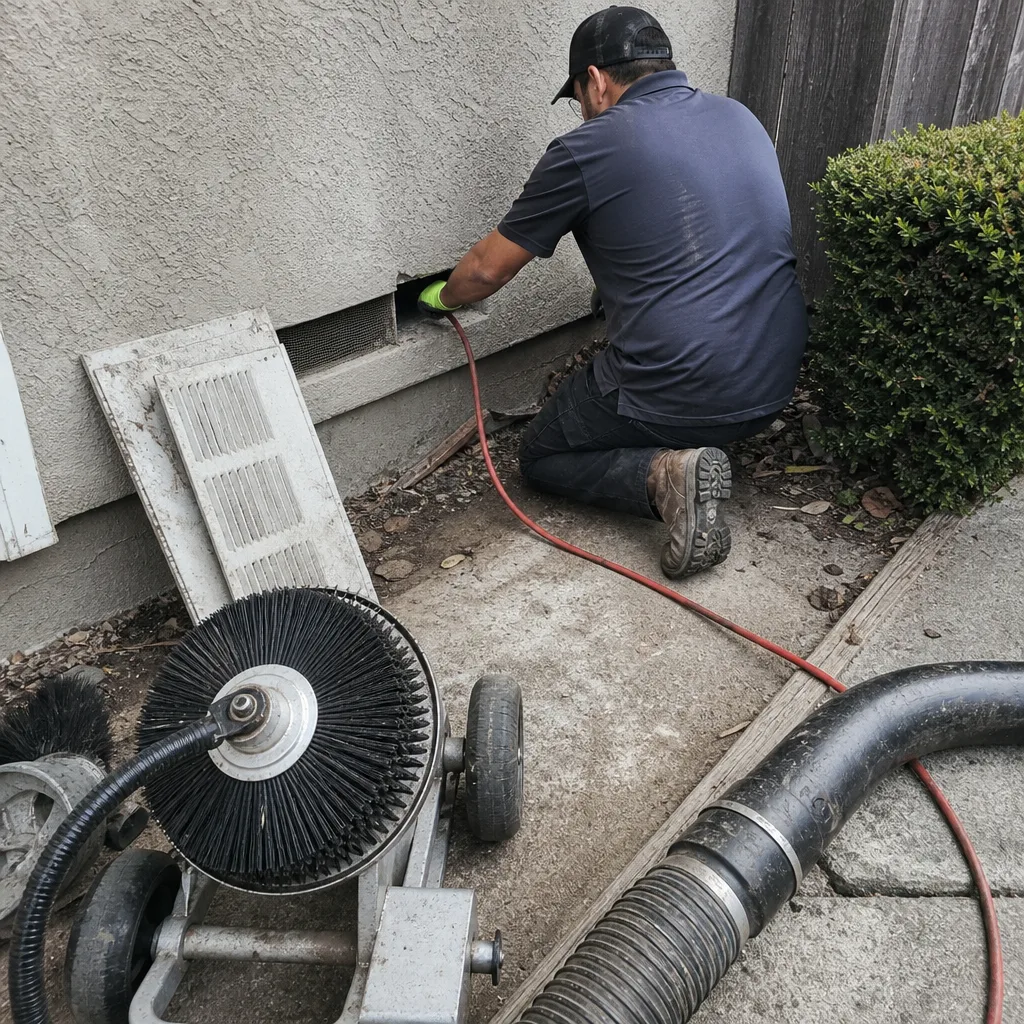
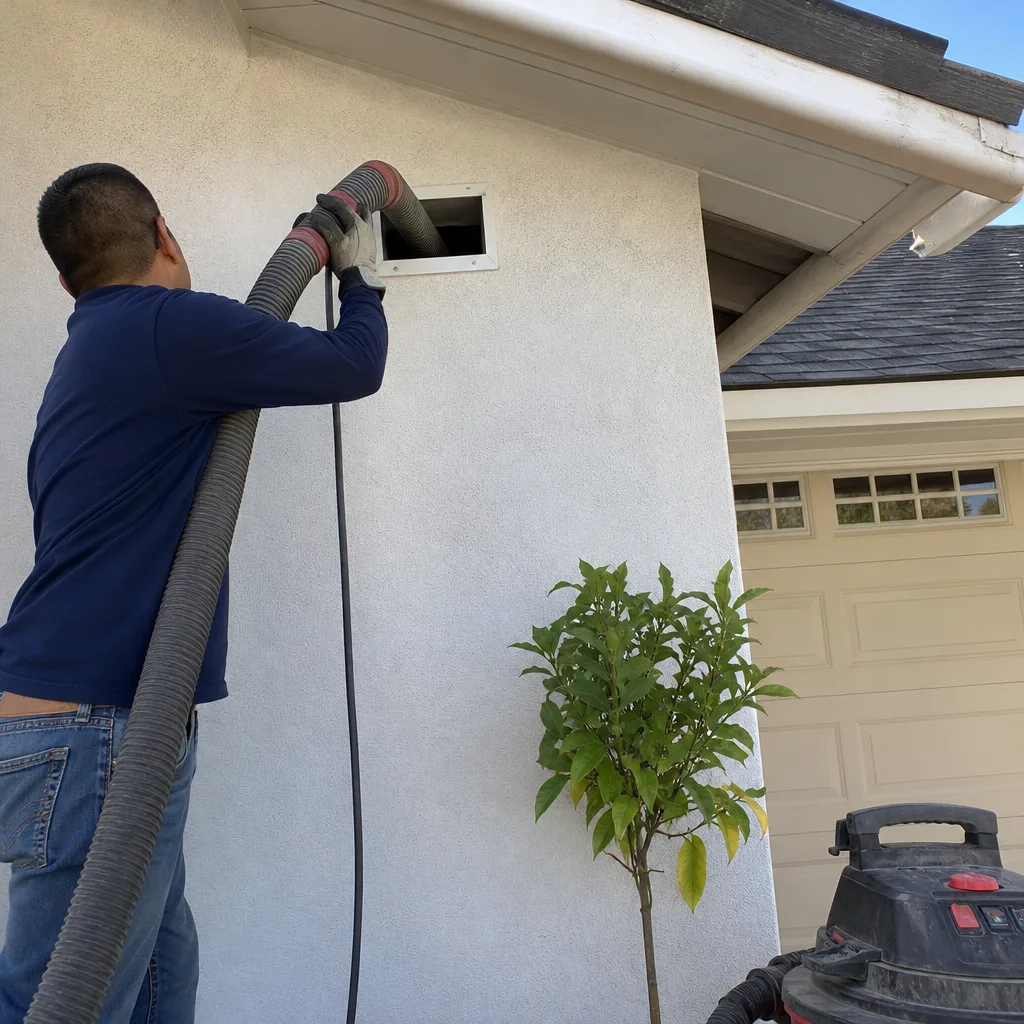
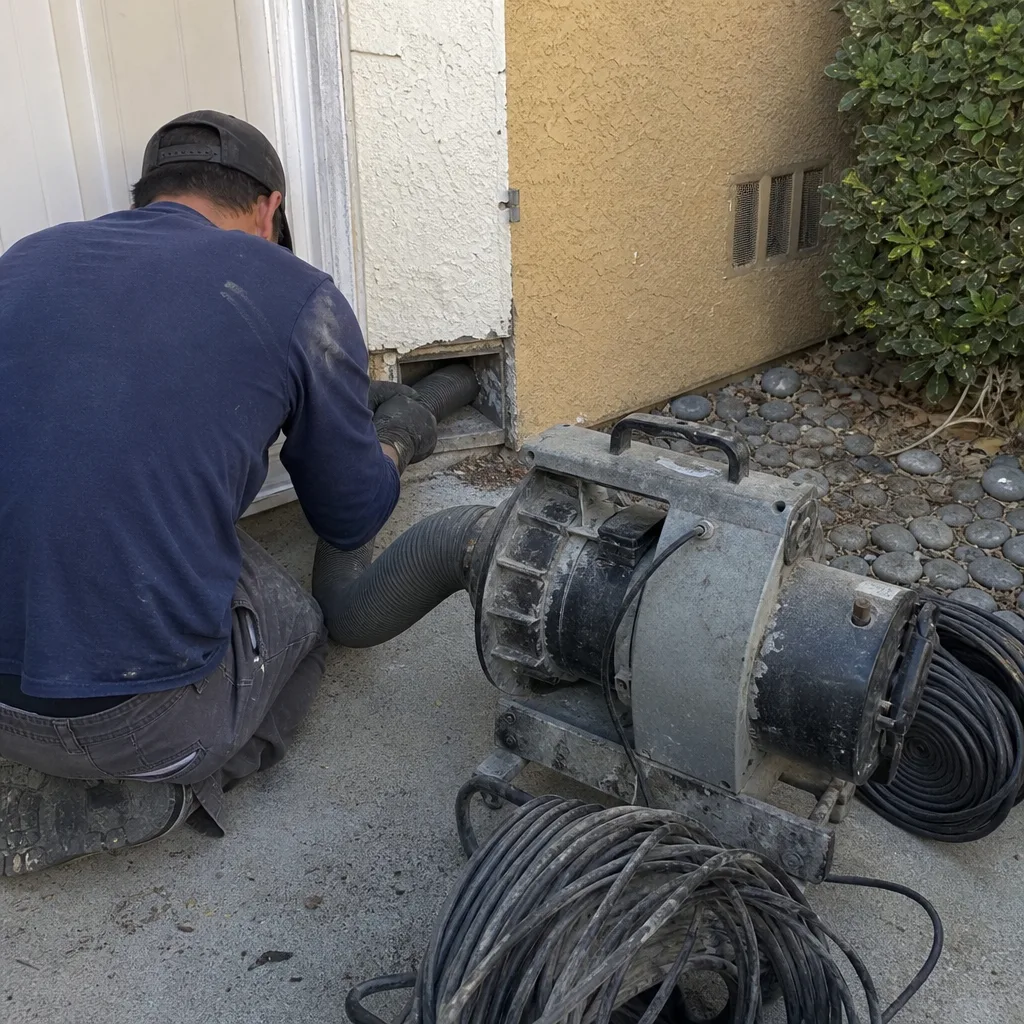
The process starts with creating negative pressure inside the duct system. A powerful vacuum unit, typically truck-mounted or a high-capacity portable unit like those from Nikro or Abatement Technologies, connects to the duct system at a strategic point, often near the plenum. This vacuum pulls the entire duct system into negative pressure, meaning that any particle dislodged during cleaning is drawn toward the vacuum rather than blown into the living space. Without this negative pressure, cleaning is essentially stirring dust around.
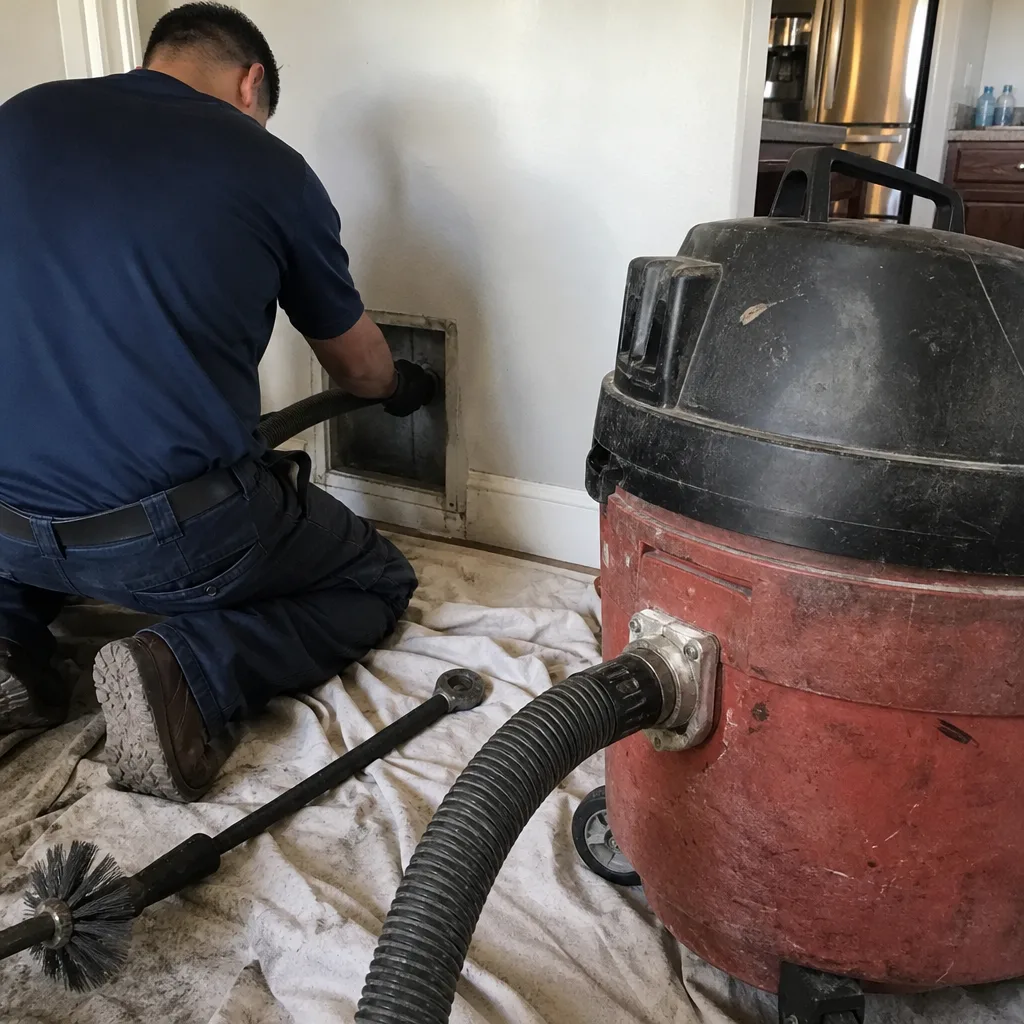
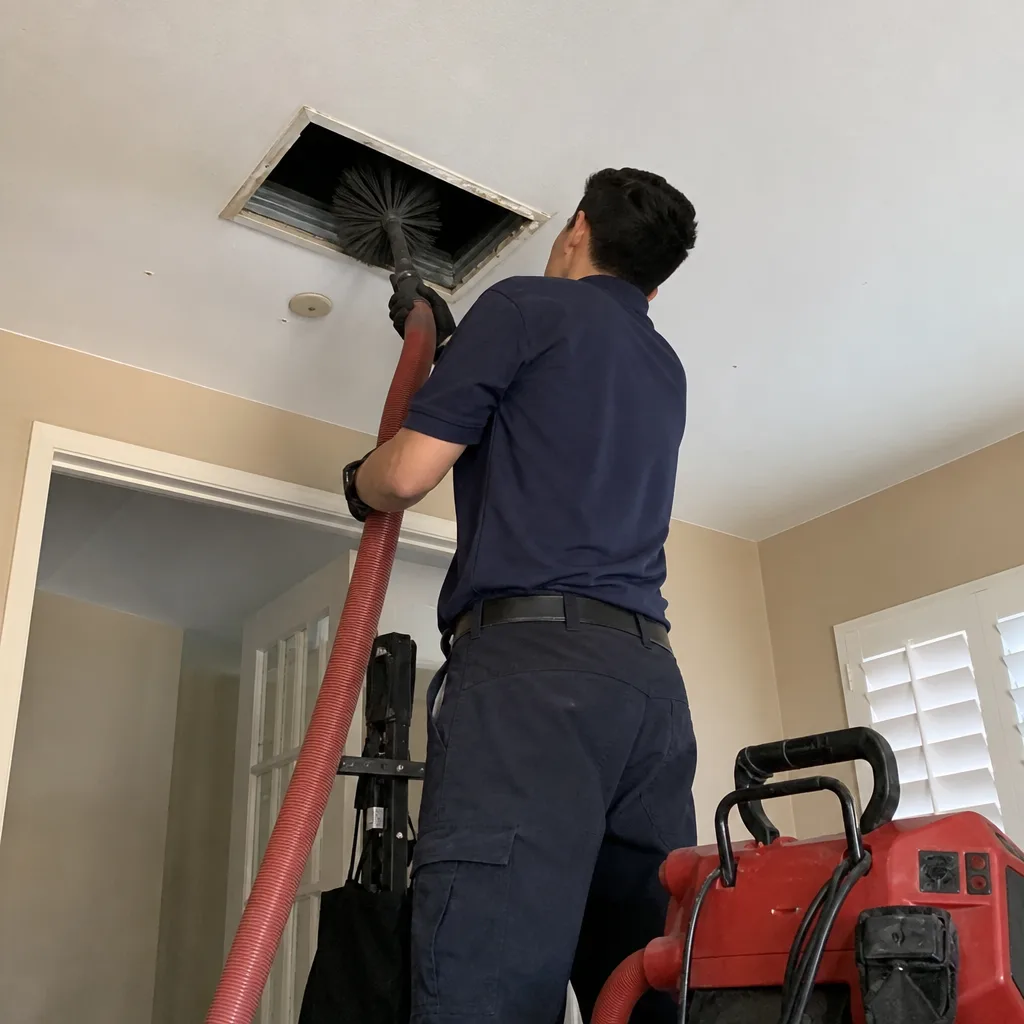
With negative pressure established, the technician works through each supply and return register, agitating the duct interior with rotating brushes fed down each run. Rotobrush systems are built for this purpose: a flexible shaft drives a brush head that scrubs the duct walls, while the negative pressure simultaneously extracts loosened debris at the collection point. The brush and vacuum work together; neither alone produces complete removal.
Access points matter. A thorough cleaning requires creating access to the main trunk line and plenum areas, not just the individual branch runs. These access holes are cut with a hole saw, cleaned, and sealed with airtight caps during the process. If a company claims to clean the trunk line without verifying access or following the airflow path, they’re not doing the same job. Professional-grade equipment including containment tools from Abatement Technologies is used to isolate the work area and protect the home during cleaning, particularly relevant when dealing with fine particulate or smoke residue.
The blower wheel is part of the job. Many duct cleaning companies skip the blower assembly, because accessing and cleaning it takes time and technical skill. But this is the component that moves your air, and a blower wheel with caked dust reduces airflow and throws balance, eventually destroying motor bearings. We clean it, because leaving it means putting a clean duct system back on a dirty fan.
Finally, verification. After cleaning, you should be able to see into accessible duct sections and observe clean metal surfaces. Before-and-after photo documentation of the main trunk and plenum confirms the work. A technician who runs a camera down a supply run and shows you the footage side by side is giving you evidence, not a claim.
Common Mistakes to Avoid
- Following a national schedule instead of a local one. The four-period cycle in Mira Mesa is specific. A cleaning every three years timed to a generic calendar may leave you with the residue of two wildfire seasons and four Santa Ana seasons baked into the system. Timing matters as much as frequency.
- Running MERV-13 filters in an undersized system during peak summer heat. We covered this above but it bears repeating: an older Mira Mesa system with a restricted return air path can freeze its coil or lose cooling capacity with a high-efficiency filter installed in July or August. Swap filters by season.
- Assuming filter replacement after a smoky period is sufficient. Smoke residue bonds to duct surfaces and continues releasing odor compounds for months. Only mechanical removal addresses it.
- Ignoring persistent wintertime cold rooms. Mira Mesa homes with rooms that noticeably underheat in winter almost always have a ducting problem, not a furnace problem. The off-season is the right time to address it. Your air duct repair options in Mira Mesa are broader and scheduling is easier than waiting until summer.
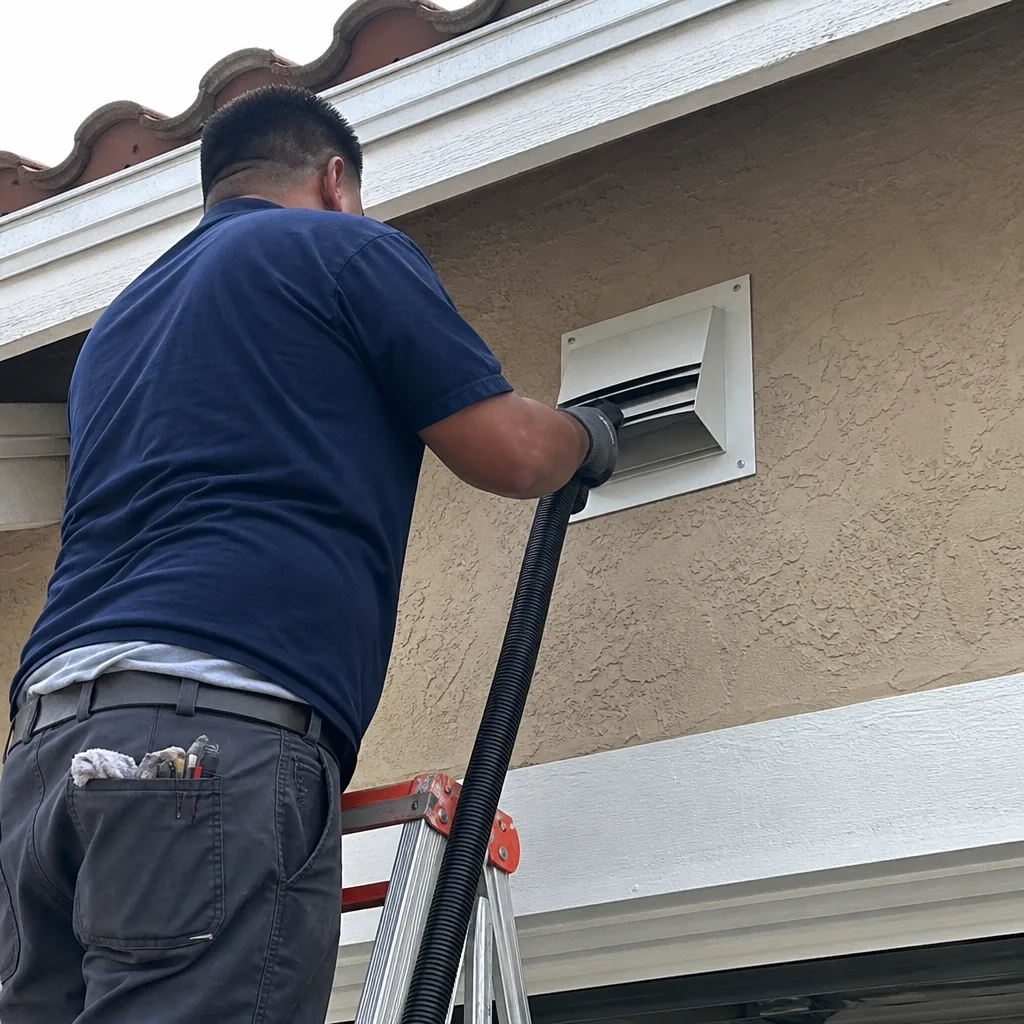
- Forgetting the dryer vent. Many homeowners think about the HVAC ducts and never consider the clothes dryer exhaust. Lint-clogged dryer vents are a leading cause of residential fires, and Mira Mesa’s dry air makes lint more combustible by removing ambient moisture. Dryer vent cleaning in Mira Mesa is a separate service requiring different tools, and it’s worth doing on its own schedule, independent of the HVAC ducts.
- Hiring on price rather than equipment and process. A duct cleaning that doesn’t use negative pressure and mechanical agitation is not the same service at a lower cost. It’s less service at a lower cost. Ask what equipment the company uses and how they verify the work.
- Expecting a filter to do a duct system’s job. Filters protect the equipment from the air; they don’t clean accumulated duct debris. If your ducts are loaded, a new filter just means the accumulated dirt stays where it is while you pay for higher pressure drop.
When to Call a Professional
Some situations are beyond homeowner inspection and require specialized equipment. If you’ve observed visible mold growth on or around registers, persistent musty odors that don’t dissipate, or moisture staining where ducts pass through unconditioned space, professional assessment is warranted. The same applies after any water event, like a roof leak or plumbing overflow, that may have introduced moisture into the duct path. Insulation contamination, where attic insulation particles enter supply air, requires repair as much as cleaning. Homes that show soiling at registers within weeks of a prior cleaning likely have an unresolved source: a return air leak pulling attic dust, a disconnected duct run, or a damaged flex connector. Air Duct Cleaning Mira Mesa offers free estimates in Mira Mesa – call (833) 734-7428 to schedule an assessment.
Frequently Asked Questions
Most Mira Mesa homes need duct cleaning every 2-3 years, with annual service appropriate for homes with pets, allergy-prone occupants, recent renovation history, or proximity to canyon edges that catch more wind-driven particulate. Use register soiling and filter loading as your indicators rather than a calendar. Call (833) 734-7428 and we’ll help you assess your specific situation.
No, smoke residue is removable, but it requires mechanical agitation with simultaneous negative-pressure extraction. Fine smoke particles bond to metal surfaces and require more contact time than standard cleaning passes. If smoke odor persists after a basic cleaning, the system may not have received adequate source removal on the blower and inside the plenum.
Only if your system is sized and ducted to handle the added airflow restriction reliably. Many older Mira Mesa homes with comfortable airflow on a MERV-8 filter will struggle on MERV-13 during peak cooling months. Use MERV-8 for summer peak, switch to MERV-13 during Santa Ana and wildfire periods, and consider a whole-home media cabinet if you want year-round high efficiency without the restriction penalty.
Late September to early October is the optimal window, placing the cleaning after peak cooling season and before the heaviest Santa Ana activity. A secondary window follows in November and December for homes that experienced significant smoke or wind events. Avoid scheduling during extreme heat when possible; the system makes its highest demand then, and you want every bit of airflow available.
Demand visual verification. A professional company will provide before-and-after photos or footage of the main trunk, plenum, and representative branch runs. You should be able to see the difference on camera. Register soiling should stop appearing within weeks, and the system should sound different on startup, meaning quieter and free of the initial rush of dust.
It can, if the system itself is contributing to indoor allergen load. Ducts that have accumulated pollen, pet dander, and fine soil particulate recirculate that material into living spaces whenever the fan runs. Removing the accumulated load plus a clean filter reduces the recirculating allergen burden. Occupants who notice worse symptoms when the HVAC runs should consider duct assessment as one factor alongside source control and filtration.
The Bottom Line
Mira Mesa’s duct care calendar doesn’t come from a national template. The marine layer’s humidity tacks dust to surfaces, summer canyon heat pushes maximum runtime and filter loading, Santa Ana winds in a fraction of a week what normally accumulates over months, and the winter mild-cycle is the opportunity to repair and prepare. Wildfire smoke behaves differently from household dust and requires a genuine source-removal process, not a vacuum pass. Filters should be matched to the season, and professional cleaning belongs in late September or after major smoke exposure. A duct system is a closed loop; what goes in stays in until someone removes it properly. Our Air Duct Cleaning Mira Mesa home page explains how our process works and what to expect from a professional cleaning.
Written by the team at Air Duct Cleaning Mira Mesa, serving Mira Mesa since 2011.
See the difference
 Before
 After
 Before
 After
 Before
 After