
Last updated November 2, 2026
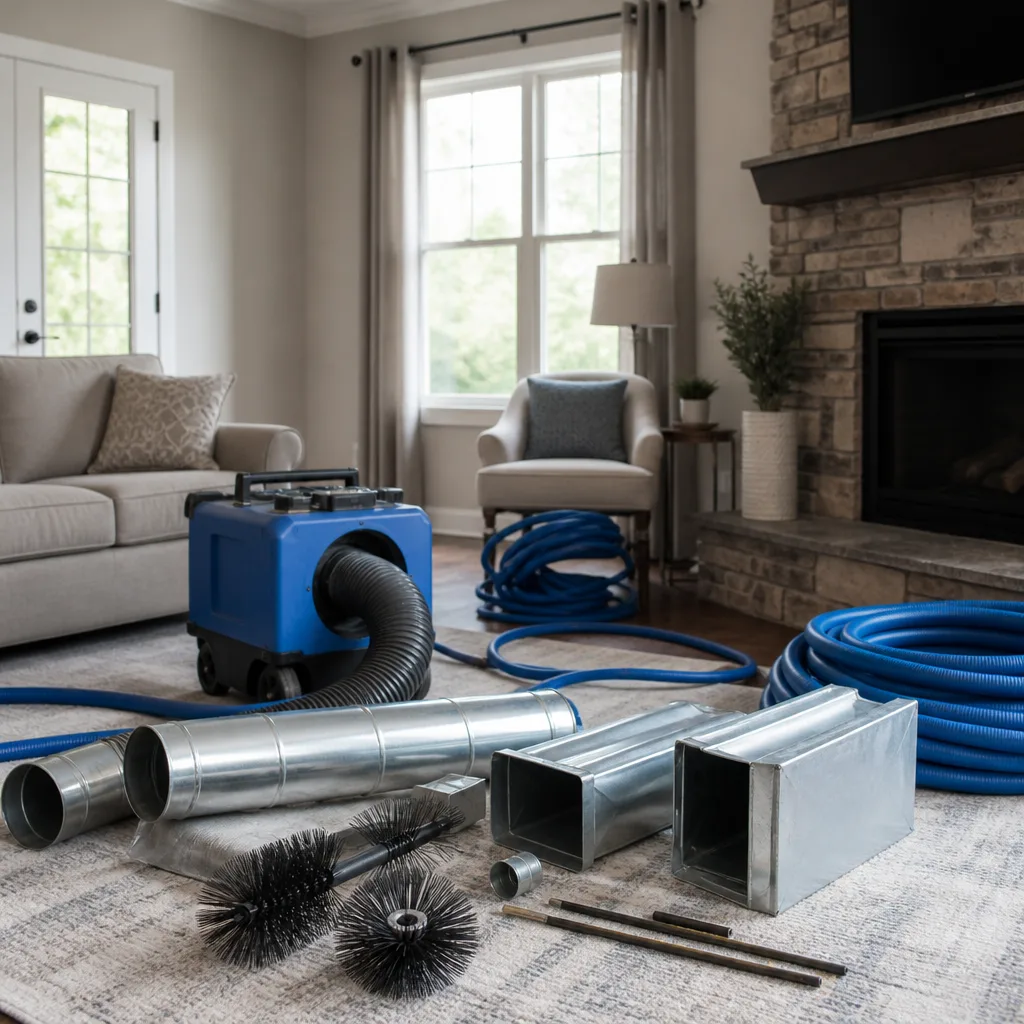 Whole-home duct cleaning
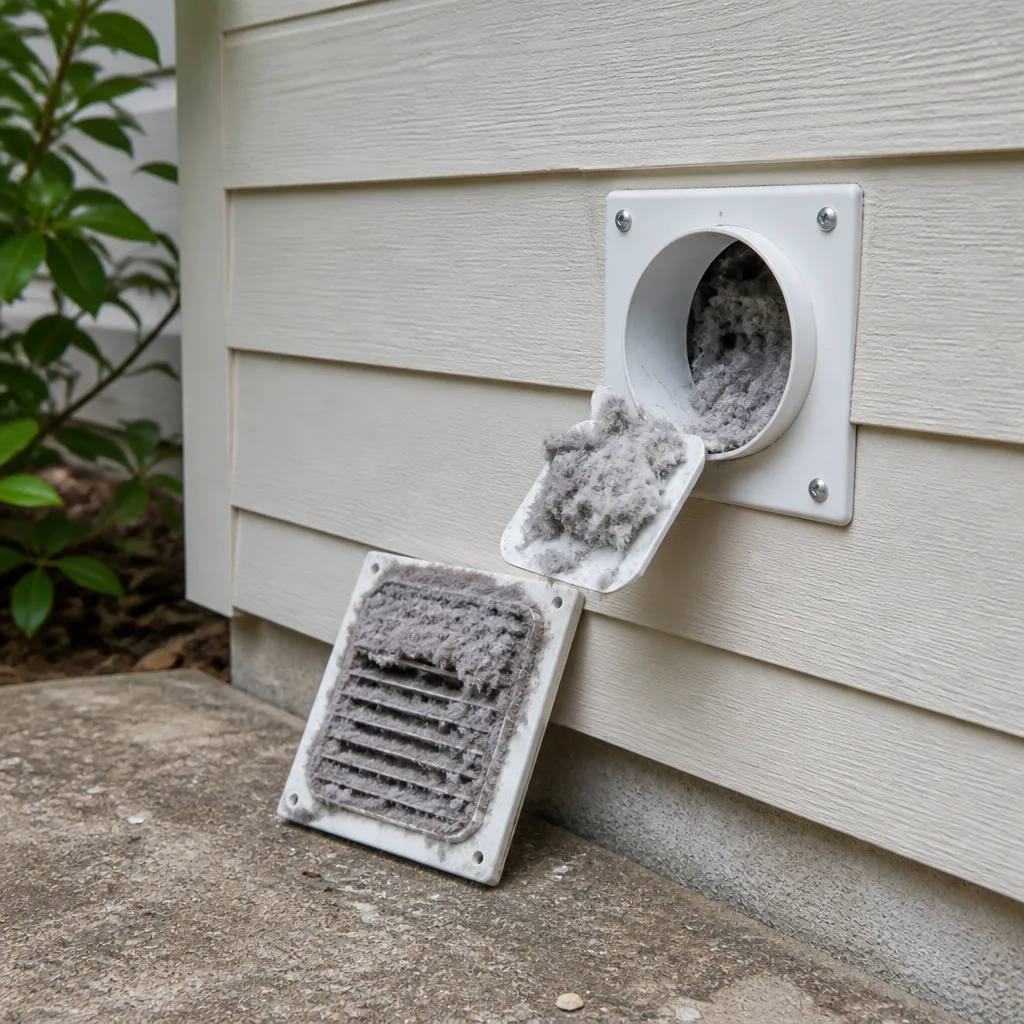 Dryer vent cleaning
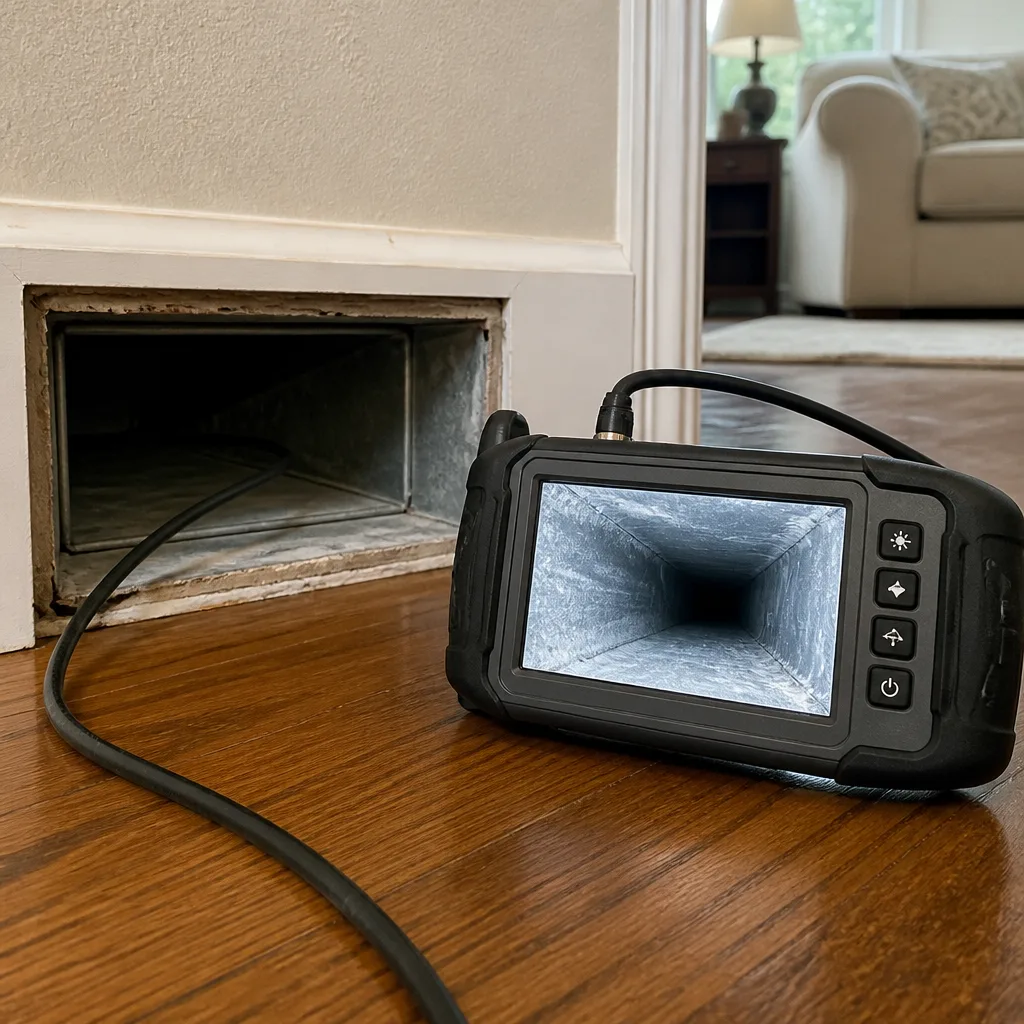 Camera inspection
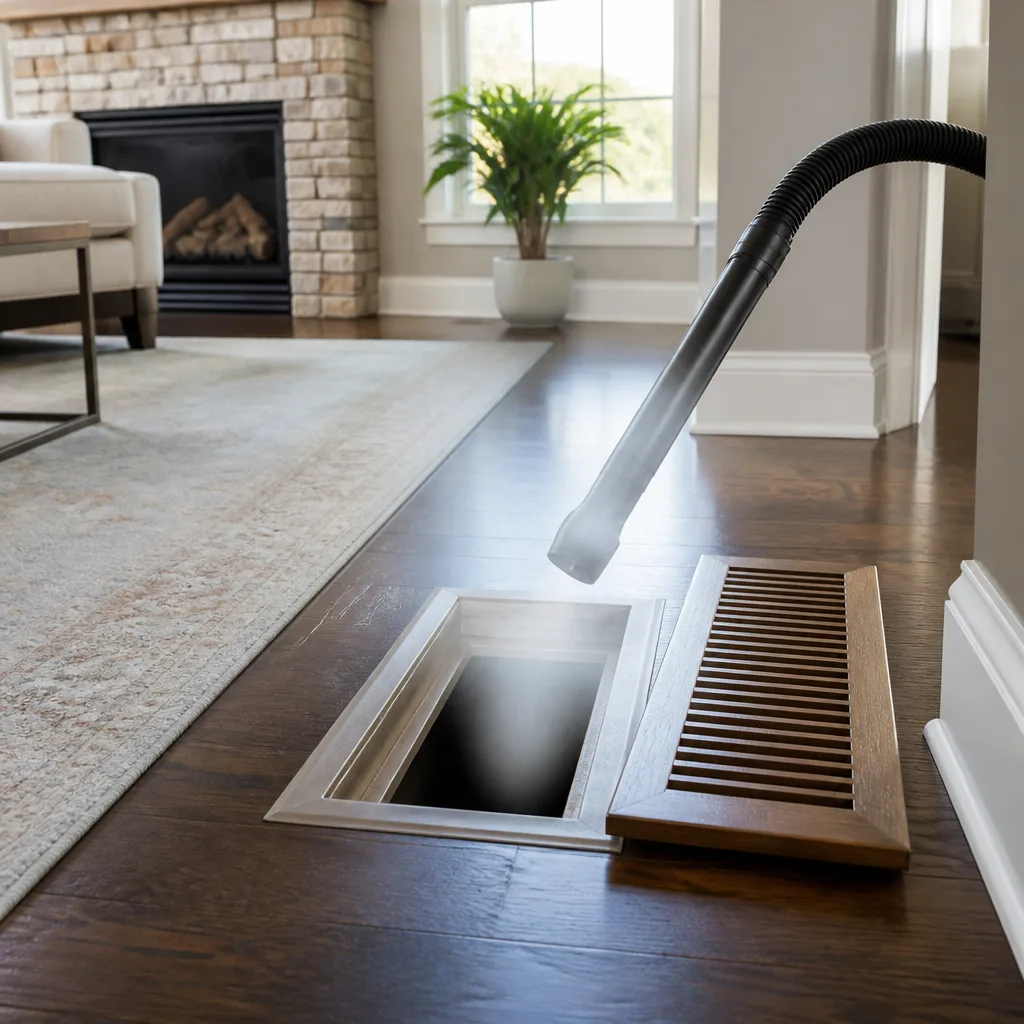 Sanitizing & deodorizing
Whole-system duct and dryer vent check with before-and-after photos - you see exactly what came out of your vents
That "$99 whole-house special" is a bait ad - the real number appears once they are in your hallway, or the "clean" is a shop-vac at the register. We photograph the inside of your ducts before and after instead.
The Complete Air Duct Cleaning Guide for Mira Mesa Homeowners
Mira Mesa sits close enough to the coast that marine layer humidity infiltrates return duct plenums in ways that don’t show up on a standard home inspection, and most cleaning checklists aren’t built to catch it. Your neighbor three streets over might need duct service on a different timeline than a homeowner in Rancho Peñasquitos, because slab-on-grade construction and 1970s tract-home duct layouts change how air moves, leaks, and collects debris. This guide explains what actually happens inside Mira Mesa ductwork, when cleaning makes sense, what commercial-grade equipment does differently, and how to read an estimate without getting taken. By the end, you’ll know exactly what questions to ask and what answers a qualified specialist should give you.
Styles & brands we work with
- Whole-home duct cleaning
- Dryer vent cleaning
- Camera inspection
- Sanitizing & deodorizing
Quick Answer
Air duct cleaning in Mira Mesa typically costs between $380 and $650 for a whole-home system, with the exact figure depending on square footage, number of returns, and whether the ductwork has never been cleaned or has visible contamination. Most Mira Mesa homes built between 1970 and 1995 have flex-duct runs through attic spaces that benefit from brush-and-vacuum extraction with negative-pressure containment, and scheduling the work takes about half a day. If you’re seeing dust return within days of cleaning surfaces, hearing airflow restrictions, or noticing musty air when the system cycles on, the ducts are the likely culprit and a professional assessment is the right next step.
Table of Contents
- Why Mira Mesa Ductwork Behaves Differently Than the National Average
- What Actually Happens Inside Your Ducts Between Cleanings
- What Commercial-Grade Equipment Actually Does Differently
- The Pre-Cleaning Inspection Checklist You Can Run Yourself
- How Often Should Mira Mesa Homeowners Clean Their Ducts?
- How to Read an Air Duct Cleaning Estimate Without Getting Taken
- When You Need Repair, Not Just Cleaning
- Common Mistakes to Avoid
- When to Call a Professional
- Frequently Asked Questions
- The Bottom Line
Why Mira Mesa Ductwork Behaves Differently Than the National Average
Most national air duct cleaning guides are written with a Midwestern or East Coast home in mind: basement furnace, rigid sheet metal trunk lines, significant heating season. Mira Mesa doesn’t work that way, and the difference matters more than most homeowners realize.
Start with the marine layer. Mira Mesa sits roughly eight miles inland as the crow flies, which puts it in a transitional zone. On mornings when the coastal cloud deck pushes east past the 805, outside humidity climbs into the 70 to 85 percent range. Your return air ducts, especially any running through unconditioned attic space, draw in that moist air every time the system cycles. When the air handler shuts off, warm attic air contacts the cooler metal or flex-duct surfaces, and condensation forms. This isn’t visible from your living room, but over time it creates a thin film of moisture on the duct’s interior walls where organic debris and fine dust stick rather than pass through.
The temperature swing compounds this. Mira Mesa regularly sees 30 to 40 degree differences between daytime highs and overnight lows during transitional seasons. That thermal cycling causes duct materials to expand and contract, which, over decades, loosens joints, pulls flex-duct connectors off their collars, and creates gaps where unconditioned air enters the system. Those gaps don’t just waste energy, they pull in attic dust, insulation fibers, and whatever else is floating in that space, adding to what’s already deposited on the duct walls.
Then there’s the construction stock. The majority of Mira Mesa’s single-family homes were built in the 1970s through early 1990s, and many use slab-on-grade foundations with the air handler tucked into a hall closet or garage niche rather than a basement. That design pushes supply and return runs up into the attic, where they’re exposed to the full temperature extremes of a southern California summer. Attic temperatures in Mira Mesa regularly exceed 140 degrees in August, and flex-duct runs through that environment degrade at a measurable rate. The inner liner becomes brittle, the insulation jacket compresses, and the duct’s ability to resist microbial growth diminishes.
So when you read generic guidance that says ducts only need cleaning every five to seven years, understand that it wasn’t written for this building stock. The environmental conditions here are different, and they warrant a different frame.
What Actually Happens Inside Your Ducts Between Cleanings
The visible dust on your registers is about 10 percent of the story. The rest happens in places you can’t see without a camera, and understanding that process makes it easier to judge when cleaning is actually needed versus when you’re being sold a service out of habit.
Here’s what accumulates inside a typical Mira Mesa duct system over the course of three to five years:
- Skin cells and textile fibers. The human body sheds roughly 500 million skin cells daily, and a good portion of them get pulled into the return air stream, especially in bedrooms where fabric fibers from bedding and carpet compound the load. This material is light and dry, but it’s also sticky. It clings to duct walls and becomes the base layer that heavier particles adhere to.
- Moisture-bound fine particulates. The condensation cycle described above turns ordinary household dust into a paste that bonds to duct interiors. Once that happens, normal airflow won’t dislodge it, and piling more dry dust on top only thickens the layer. This is why some ducts look surprisingly clean from the register but test poorly when cameras are run into the return trunk.
- Attic infiltration debris. When flex-duct connectors loosen in attic runs, the system’s negative pressure actively pulls in loose-fill insulation, rodent droppings, and dust from the attic floor. We’ve seen return plenums in Mira Mesa homes with a quarter-inch of blown-in fiberglass coating the bottom, all infiltrating through a gap no one noticed because it was hidden behind a vent boot.
- HVAC filter bypass material. Most residential filter racks have small bypass gaps around the frame, and the filter itself only captures particles down to a certain micron size. The finer stuff passes through, enters the blower compartment, and deposits on the evaporator coil and downstream duct surfaces. If your filter is a basic fiberglass panel, you’re capturing mostly the heavy visible dust and letting the finer load through.
- Household specific contaminants. Pet dander from animals, cooking oils from kitchens without proper exhaust ventilation, candle soot from scented candles burned regularly, and construction dust from any past remodeling that wasn’t adequately sealed off. Each of these has a different density and adhesion profile, which is why cleaning effectiveness depends on matched agitation methods, not just suction power.
None of this implies a health emergency. Ducts are not sterile environments, and they’re not supposed to be. But when the accumulation reaches the point where it’s insulating the duct walls, restricting airflow, or cycling fine particles back into the living space every time the blower runs, it’s a mechanical efficiency problem and a comfort problem worth addressing.
What Commercial-Grade Equipment Actually Does Differently
The single biggest differentiator in Mira Mesa duct cleaning is the equipment, and it’s where most homeowners get misled. A generalist HVAC company that offers duct cleaning as a sideline typically uses a portable vacuum the technician rolls to the register and a spinning brush of questionable diameter. That approach does dislodge some surface dust, but it doesn’t address the duct system as a contained pneumatic environment, and it often leaves more material behind than it removes.
Commercial-grade systems work on a different physical principle: negative-pressure containment. Here’s the sequence we run on an Air Duct Cleaning in Mira Mesa job:
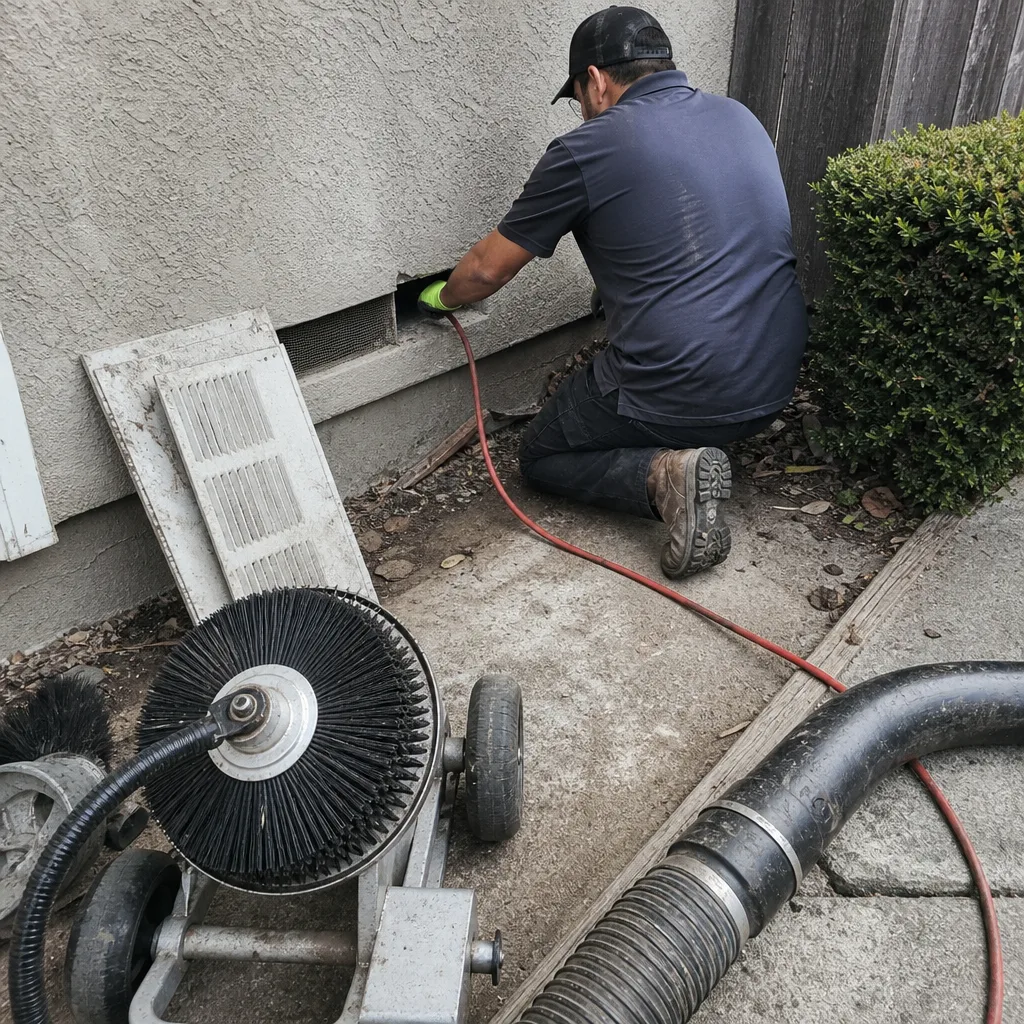
- Negative air is established first. A high-capacity vacuum unit, typically a Nikro or Abatement Technologies system, is connected to the main supply trunk or return plenum before any brushing starts. This creates continuous suction through the entire duct network, which means any particulate dislodged downstream is pulled toward the collection point rather than drifting out of registers into the living space. It’s the same containment principle used in commercial mold remediation, applied at residential scale.
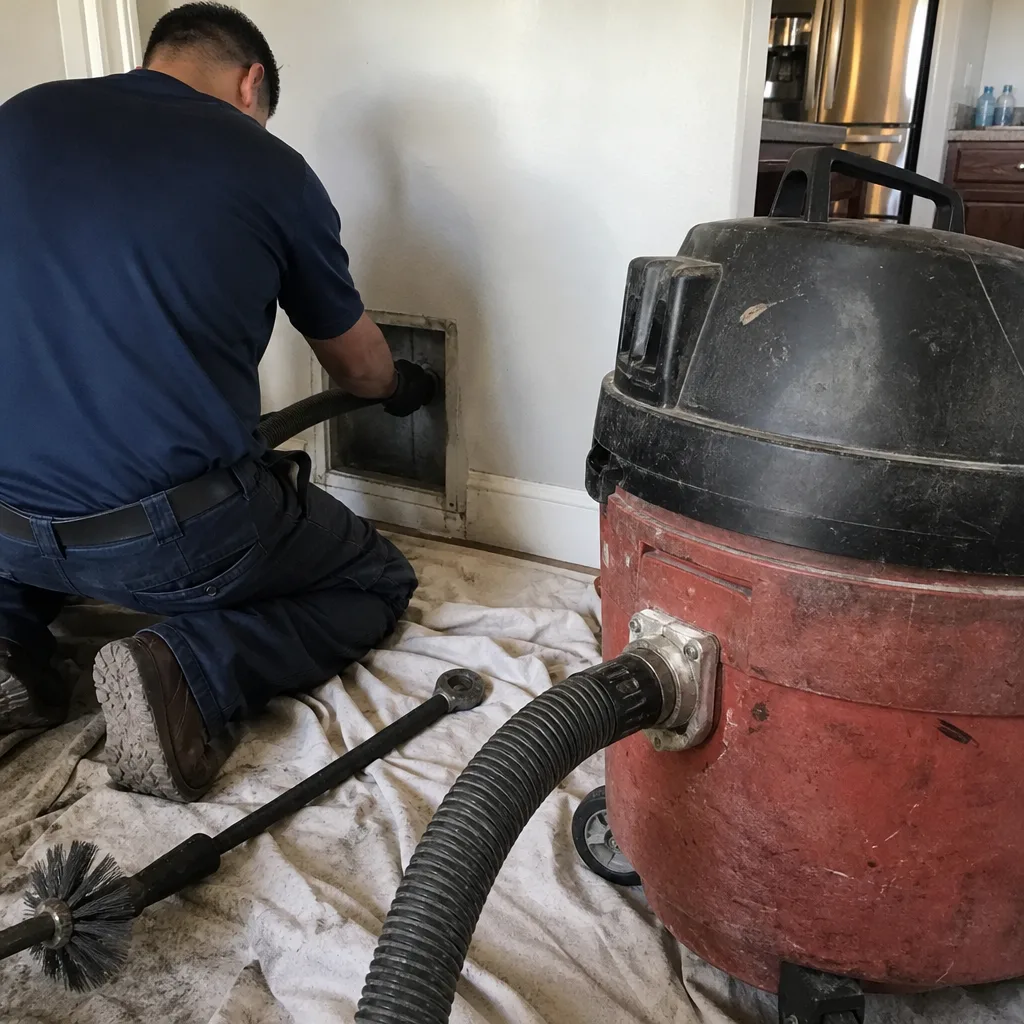
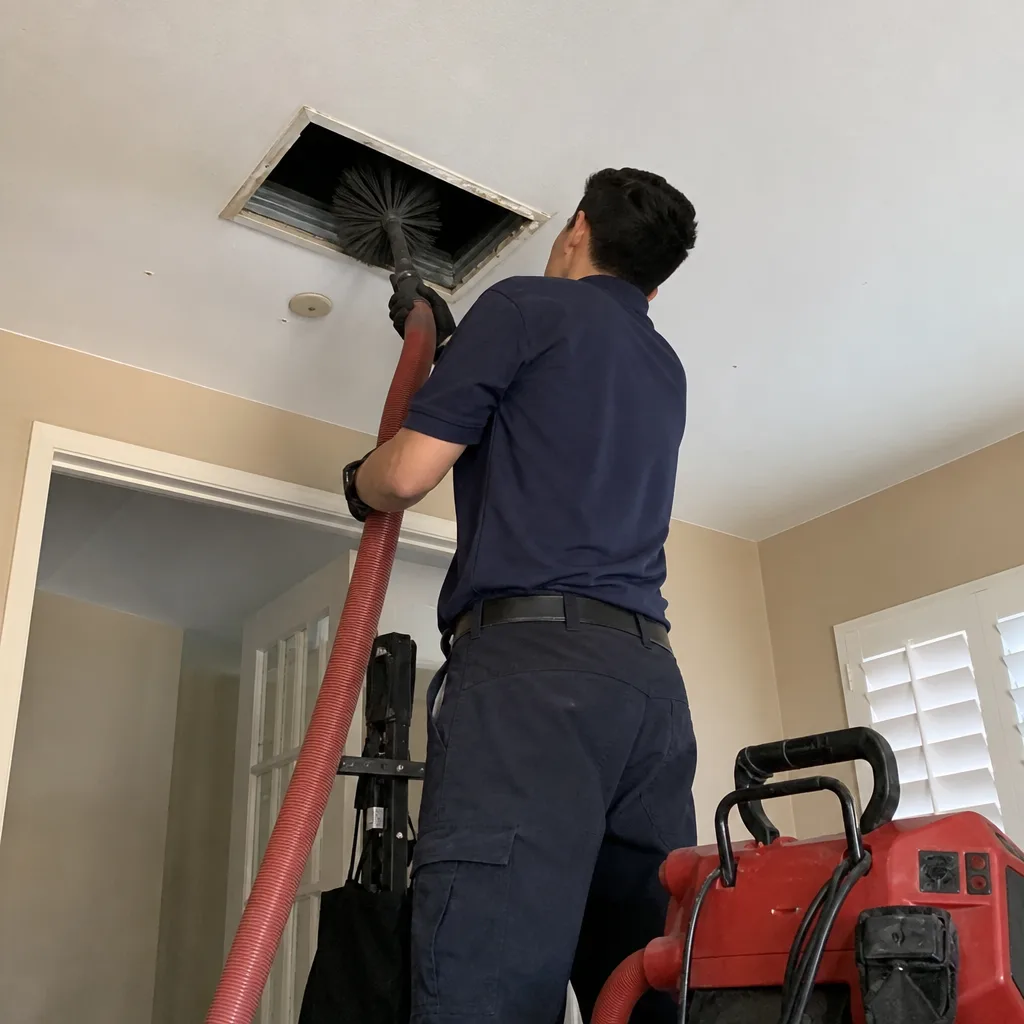
- Rotobrush agitation is applied from the branch runs. With negative pressure running, technicians access each branch duct from the register and push a powered brush down toward the main trunk. The rotating bristles mechanically break the adhesion between dust accumulations and duct walls. Loose particulate immediately enters the airstream and is carried to the vacuum. This is aggressive enough to remove the moisture-bound deposits described earlier, which passive vacuuming alone won’t touch.
- The return side gets equal attention. Most low-competence cleanings focus on supply ducts because that’s what homeowners see at the register. The return side, especially the return plenum and filter rack area, typically holds the highest contaminant load in a Mira Mesa home because it’s before the filter, not after it. We treat the return trunk as a primary cleaning target.
- Post-cleaning verification is part of the job. Before-and-after visibility is not a luxury. A properly equipped crew runs a camera into the cleaned duct sections to verify that the surfaces have been returned to bare material. If there’s still a visible coating, the job isn’t done. The Air Duct Cleaning Mira Mesa home standard is that you should see the difference with your own eyes before you sign off.
The Pre-Cleaning Inspection Checklist You Can Run Yourself
Before you call anyone, spend 20 minutes gathering evidence. A competent specialist will appreciate that you’ve done this, and it gives you a baseline for evaluating whether the scope of work you’re quoted is honest. Here’s what to do, in order:
- Pull two or three supply registers and look inside with a flashlight. Remove the register face by unscrewing it or popping the clips, and shine a light down the duct run. Clean sheet metal should reflect light cleanly. If you see a fuzzy gray or brown coating, accumulated debris, or visible dust clumps, that’s a surface that hasn’t cleared itself. Don’t stick your hand in and wipe; you’re documenting, not cleaning.
- Check the return plenum at the air handler. Find your furnace or air handler cabinet, often in a hall closet or garage in Mira Mesa homes, and open the return side access panel if it’s accessible without tools. Fire the unit off, take a look at the filter, and shine a light past it at the blower compartment. A heavy layer of dust on the blower housing or filter rack means particulate has been passing through for a while.
- Inspect the filter itself. Pull the filter and hold it to a light. If it’s densely loaded with gray or brown material and the system has only been run for a month or two, that’s a sign the duct stream has an upstream deposit. If it’s a reusable filter that hasn’t been washed in months, start there before blaming the ducts.
- Walk the attic and check flex-duct connections. If you have attic access, take a look at the duct runs. Look for collapsed or kinked sections, disconnected joints where a flex duct has pulled off a round collar, and compression from stored items. Any of these creates an infiltration point and, if left unrepaired, cleaning the ducts won’t keep them clean. This is a visual inspection only; don’t crawl around on attic joists without proper support and lighting.
- Note indoor environmental symptoms. Write down what you’re actually experiencing: excess dust settling within days of cleaning, stale or musty odor when the system cycles, inconsistent room temperatures suggesting airflow restrictions, higher utility bills during peak summer cooling months. These observations tell the specialist where to look and what to prioritize.
How Often Should Mira Mesa Homeowners Clean Their Ducts?
The honest answer is that it depends on your house, your habits, and your sensitivity, not on a marketing calendar. But there are defensible baselines for this area.
For most Mira Mesa homes with a standard filter and no unusual contamination sources, cleaning every four to five years is a reasonable maintenance interval. That’s not the number a drive-by coupon mailer will quote you, but it reflects the observed deposition rate in this climate. Homes with pets that shed continuously, smokers, frequent candle use, or ongoing construction dust from nearby development projects may warrant a three-year interval. Mira Mesa has seen continuous infill development over the past decade, and homes near active construction zones accumulate construction dust at an accelerated rate even when windows are closed, because fine particulates enter through make-up air paths and get distributed by the HVAC system.
There are also trigger events that should prompt an immediate cleaning regardless of the calendar, and these are non-negotiable:
- Water intrusion into the duct system from a roof leak, condensation overflow, or plumbing incident. Wet duct insulation or visible moisture inside ducts is a condition that requires drying and cleaning, not waiting.
- Rodent activity in the attic or inside ducts themselves. Droppings, nesting material, and urine contamination in ductwork is a health hazard that needs professional handling, not a homeowner DIY weekend.
- Post-remodel cleaning. If you’ve had drywall work, flooring removal, or attic insulation updated, the duct system has been exposed to construction dust. This is suspended, fine, and easily distributed throughout the house on the next system cycle.
- Moving into a previously owned home. You have no idea what the previous occupants put through the system. Treat duct cleaning as part of move-in preparation, alongside carpet cleaning and painting.
How to Read an Air Duct Cleaning Estimate Without Getting Taken
The duct cleaning industry has an overreputation for bait-and-switch pricing, and the Mira Mesa market is not immune. The bad actors use a simple model: advertise a low per-room or whole-house teaser price, show up with a small shop-vac unit, and then start piling on upsells for sanitizing, deodorizing, mold treatment, and duct sealing that the system didn’t actually need. By the time the invoice prints, the $99 special has become $900, and you can’t verify whether any of the extra work was done.
Here’s how to filter a legitimate scope of work from a padded one, using the line items as evidence:
- Look for real equipment named in the scope. A credible estimate will specify the cleaning methodology: brush agitation, negative air extraction, HEPA-filtered vacuum unit, containment sealing. “Complete duct cleaning” without any equipment identification is a signal the company is using a truck-mounted or consumer vacuum and doesn’t want you to ask what’s actually connected to your ducts.
- Separate cleaning from repair line items. Duct cleaning is a defined scope. Duct repair is a separate service. A good estimate will not bundle them ambiguously. If you see $300 for “system restoration” with no explanation of what specific damage was observed, ask for a camera image before paying it.
- Be suspicious of compulsory sanitizing add-ons priced high. Antimicrobial fogging of duct interiors is occasionally warranted after water damage or confirmed microbial contamination, but it’s not a routine part of every cleaning, and it shouldn’t be forced into the scope as a mandatory upgrade. If the technician hasn’t shown you visual evidence of contamination, you don’t need the chemical treatment.
- Expect a whole-system flat price, not a per-vent price. Companies that price per vent inflate the final bill by qualifying “standard” versus “deep” cleaning differently at each register. A professional firm will quote one flat price for the entire system scope, agreed before work starts, with any additional findings handled as a separate, clearly-explained change order you approve in writing.
- Ask if Air Duct Repair in Mira Mesa is handled in-house. Many companies that clean ducts won’t touch a disconnected flex run or a crushed section they find during the process, which leaves you with a clean system that’s still leaking. The ability to repair findings during the same service call is a significant operational advantage and a signal that the company stands behind the condition of the entire duct system, not just the surfaces they can brush.
When You Need Repair, Not Just Cleaning
Here’s a distinction that saves Mira Mesa homeowners real money: cleaning and repair are different services with different objectives, and cleaning alone cannot fix mechanical duct failure. If your duct system has physical damage, no amount of brushing or vacuuming will restore performance, and paying for cleaning while ignoring the damage is wasted money.
Signs that you’re dealing with a repair issue rather than a cleaning issue include:
- Rooms that never reach setpoint. If one bedroom in your Mira Mesa home is always five degrees warmer in summer regardless of vents being fully open, you likely have a collapsed or disconnected flex run in the attic serving that room. The air is being delivered to the attic instead of the room. Cleaning won’t fix a collapsed duct; it needs replacement or reconnection.
- Visible duct material at the register. When you pull a register and see torn inner liner, separated insulation, or a duct that’s collapsed under its own weight, the duct needs repair.
- Unexplained energy bill increases. A 20 to 30 percent jump in cooling costs with no change in weather or usage patterns often traces back to conditioned air leaking into unconditioned spaces through failed duct connections. The system is working harder to cool the attic.
- Air handler cycling frequently. If the system runs constantly but the house never feels comfortable, the blower may be pushing against damaged ductwork, or pulling attic air through return-side gaps. This is a repair diagnostic, not a cleanliness issue.
In our experience, roughly three to four out of ten homes built before 1995 in Mira Mesa and surrounding communities have at least one duct repair need that goes unaddressed at any given time. The problem is typically a disconnected flex collar in the attic, a crushed section under stored items, or a return plenum leak where the cabinet meets the wall. None of these conditions improve with cleaning. They require physical correction. If your duct cleaner finds these issues and can’t fix them, you’ve paid for a partial solution and will need to hire someone else to finish the job. An Air Duct Repair in Mira Mesa specialist handles both.
Common Mistakes to Avoid
- Buying the cheapest quote. The $79 whole-house special is priced for a reason: the company plans to spend 40 minutes at your register and upsell you on add-ons once they’ve created doubt. Commercial-grade equipment costs real money to operate, and the labor takes four to six hours for a single-system Mira Mesa home. There’s no way to deliver that at $79 and stay in business without a bait-and-switch.
- Using the wrong filter in the name of better air quality. Installing a high-MERV filter in a system not designed for the additional static pressure strains the blower motor and reduces airflow. Most Mira Mesa residential air handlers are sized for MERV 8 to 11 filters. If you want better filtration alongside clean ducts, consult your system documentation or ask a professional before upgrading.
- Running the system during renovation. If you’re doing drywall work or flooring removal, shut the system down and seal the returns during the work, or clean the ducts immediately after. Construction dust drawn into the ducts will take months to fully cycle out, and it coats every surface in the process.
- Ignoring visible moisture. Condensation on duct surfaces, water stains at register boots, or a musty smell when the system runs are not normal and not acceptable. Moisture in ductwork creates conditions for biological growth that no amount of dry brushing later will fix. Address the source of the moisture, then clean and verify.
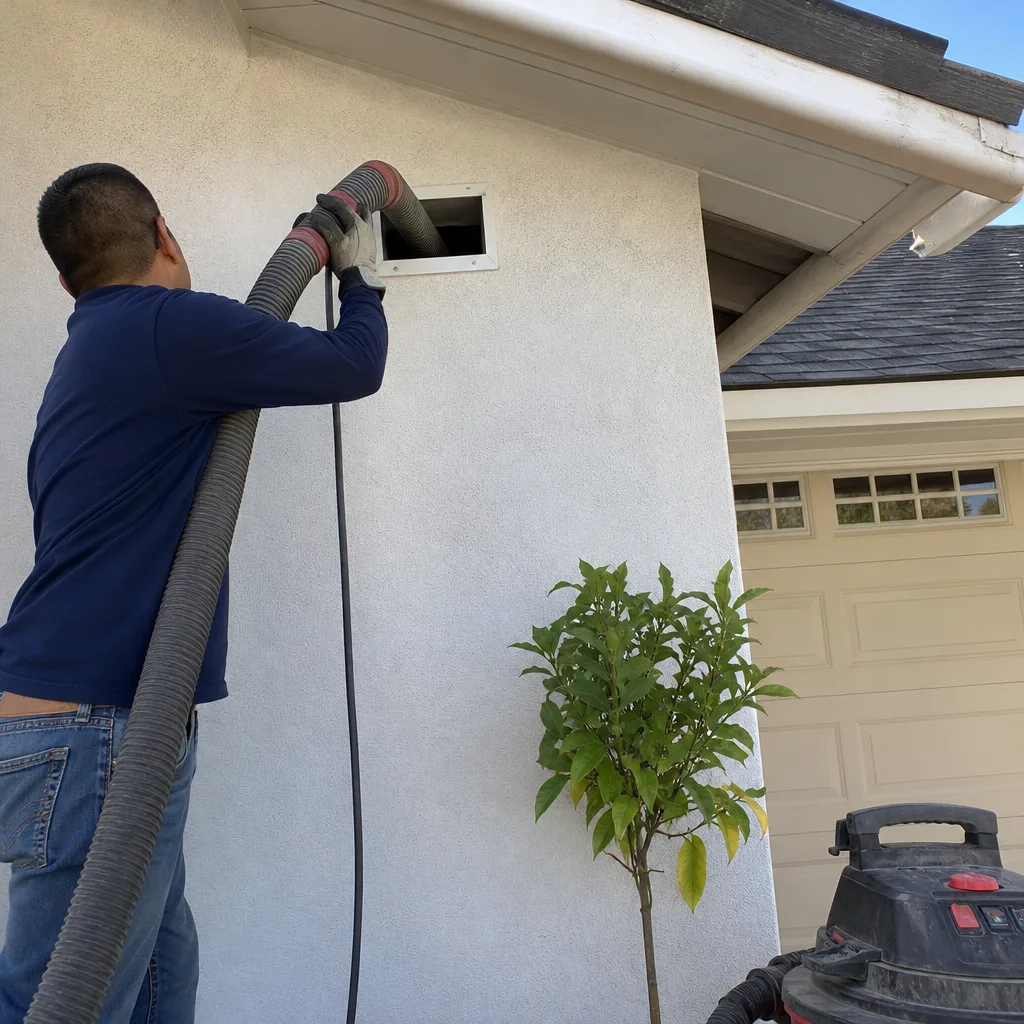
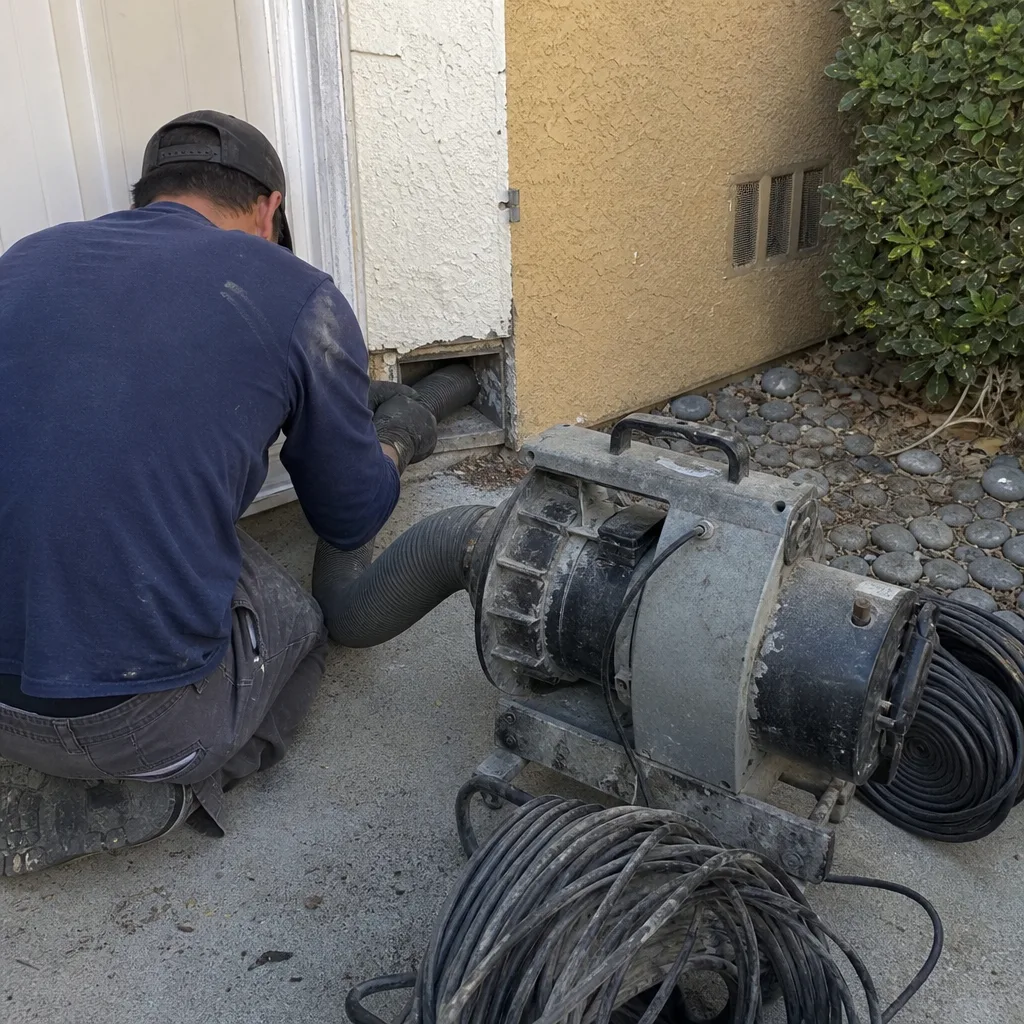
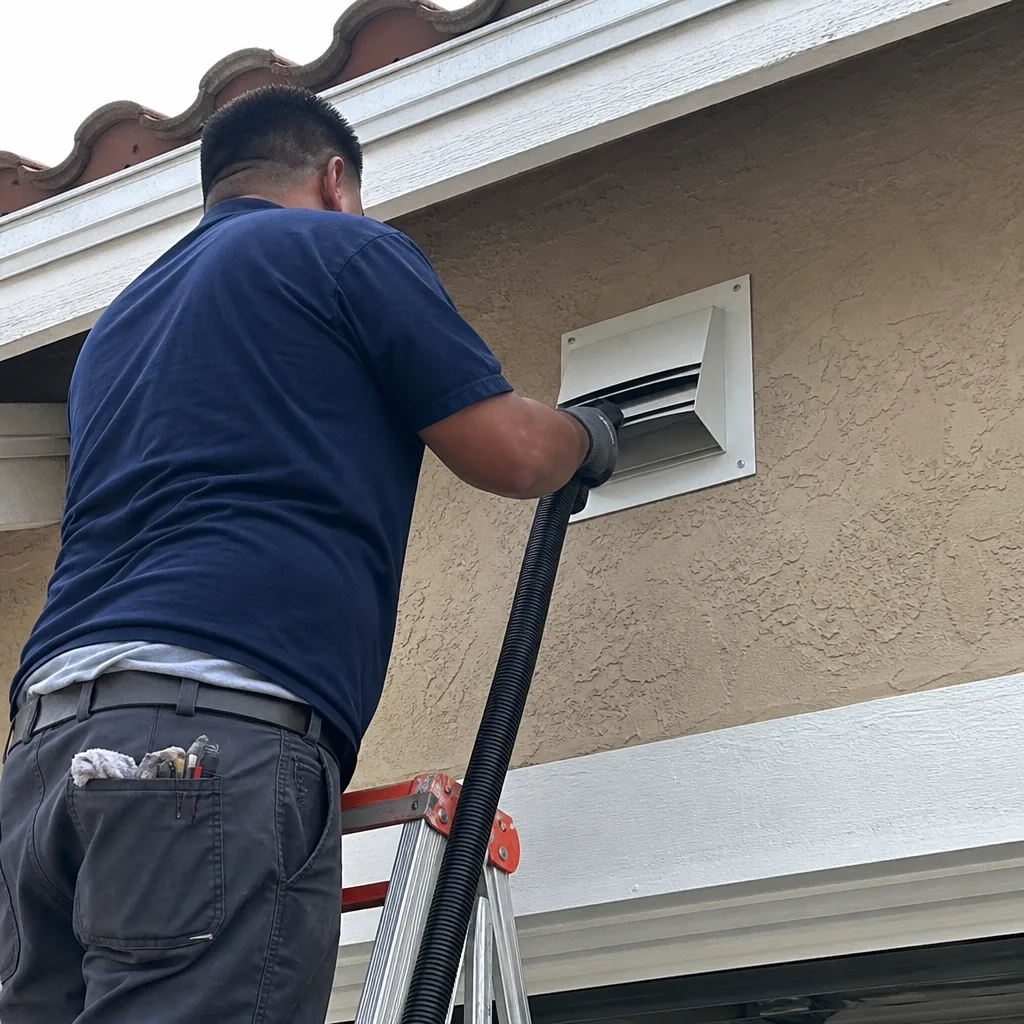
- Assuming your dryer vent is part of a standard duct cleaning. It isn’t. The dryer exhaust is a separate duct run serving a separate appliance, and it accumulates lint through a completely different mechanism. It warrants its own dedicated service, which we perform separately for exactly this reason. For homes with long vertical dryer rises, this is a fire-safety priority, not an optional extra.
- Hiring a company based on a franchise brand name. National franchise duct cleaning operations are independently owned and operated, and the quality at your Mira Mesa home depends entirely on the local crew’s training and equipment, not the logo on the van. Ask specifically what equipment will be used at your address and who will be performing the work.
When to Call a Professional
If you’ve done the self-inspection checklist and found visible duct coating, disconnected runs, or filter-bypass evidence, or if you’re experiencing persistent dust and airflow problems that don’t resolve with filter changes, it’s time to bring in equipment that can actually access the full duct network. Do not attempt to clean your own ducts with a shop vac and a household brush; residential extension tools can’t reach more than a few feet down the run, and swirling dust loose without containment just circulates it through the house. Professional negative-air systems is the only way to clean the entire run length safely and verify the result. Air Duct Cleaning Mira Mesa offers free estimates in Mira Mesa, call (833) 734-7428 to schedule an inspection and a flat-price scope of work.
Frequently Asked Questions
Whole-home air duct cleaning in Mira Mesa currently runs between $380 and $650 for most single-family homes, depending on total duct length, the number of returns, and the degree of contamination present. Homes with multi-zone systems, unusually long attic runs, or previous water damage may run higher, while smaller single-story homes with compact layouts may fall at the lower end. The price should be quoted as one flat system price before work starts, not per vent or per room. Call (833) 734-7428 for an exact quote for your home, estimates are free.
Cheaper quotes almost always indicate a different service model: shorter time on site, smaller or consumer-grade vacuum equipment, no containment setup, and no before-and-after verification. The company may be planning to clean only the first few feet of each duct run, or they may be using the low quote as a lead generator for aggressive upsells once they’re in your home. Professional-grade systems that use negative air containment and powered agitation simply take longer and cost more to operate, and that difference shows up in the honest price.
Require before-and-after photo or video documentation of the duct interiors, not just the registers. A legitimate specialist runs a camera into the cleaned supply trunks and return plenum and shows you the surfaces. If the company can’t or won’t provide this, walk away. Clean metal should appear uniformly bare, and flex duct interiors should show the original liner color without visible debris accumulation. We provide this verification as a standard part of every cleaning.
Every four to five years is a defensible interval for most Mira Mesa homes with standard filtration and no unusual contamination sources. Homes with heavy pet dander, recent construction exposure, or family members with significant respiratory sensitivities may benefit from a three-year interval. The calendar matters less than the condition; use the self-inspection checklist annually and clean when evidence appears. Some homes genuinely need cleaning at eight years, though they’re the exception rather than the rule in this climate. Call (833) 734-7428 if you’re unsure whether your ducts are ready.
Air duct cleaning is worth the money when it’s needed and performed competently; it’s a scam when it’s sold aggressively to people who don’t need it using equipment that can’t actually clean a full duct run. The bad reputation comes from the latter camp. If your ducts have visible buildup, you’re experiencing persistent dust, or you have a trigger event like water intrusion or construction dust exposure, professional cleaning with proper equipment delivers measurable results: cleaner air, better airflow, reduced system strain, and confirmation that your ducts aren’t leaking. If none of those conditions exist and you’re just getting a coupon in the mail, you can probably wait.
It can, but only when the ducts have enough buildup to restrict airflow or when cleaning reveals leakage that then gets repaired. A heavily coated duct interior reduces effective diameter, which increases static pressure and makes your blower work harder to move the same air volume. Removing that restriction restores airflow and allows the system to reach setpoint more efficiently. However, if your ducts are relatively clean and your problem is actually a leak or a disconnected run, cleaning alone won’t move the bill. That’s why the assessment matters: a good specialist identifies the actual issue before recommending a scope. For dryer vent cleaning, which is a separate service addressing lint buildup, the efficiency gain is from restoring proper exhaust airflow and reducing drying time, also saving energy.
The Bottom Line
Mira Mesa’s climate and housing stock create specific conditions that generic duct cleaning advice doesn’t account for. Marine moisture, attic-exposed flex runs, 1970s-to-1990s construction, and ongoing regional development all influence how quickly your ducts accumulate debris and whether that debris affects your system’s performance. The right approach is inspection-led, equipment-serious, and honest about the boundary between cleaning and repair. If you’re seeing dust return quickly, noticing airflow problems, or buying filters more often than you should, call Air Duct Cleaning Mira Mesa at (833) 734-7428 for a free, no-commitment assessment of your duct health using commercial-grade diagnostic and cleaning equipment, including Rotobrush, Nikro, and Abatement Technologies systems.
Related services: Dryer Vent Cleaning in Mira Mesa handles the separate lint exhaust system behind your dryer, which is a fire-safety priority that standard duct cleaning does not address. Air Duct Repair in Mira Mesa addresses disconnected flex runs, crushed sections, and return plenum leaks that cleaning alone cannot fix.
Written by the team at Air Duct Cleaning Mira Mesa, serving Mira Mesa since 2011.
See the difference
 Before
 After
 Before
 After
 Before
 After